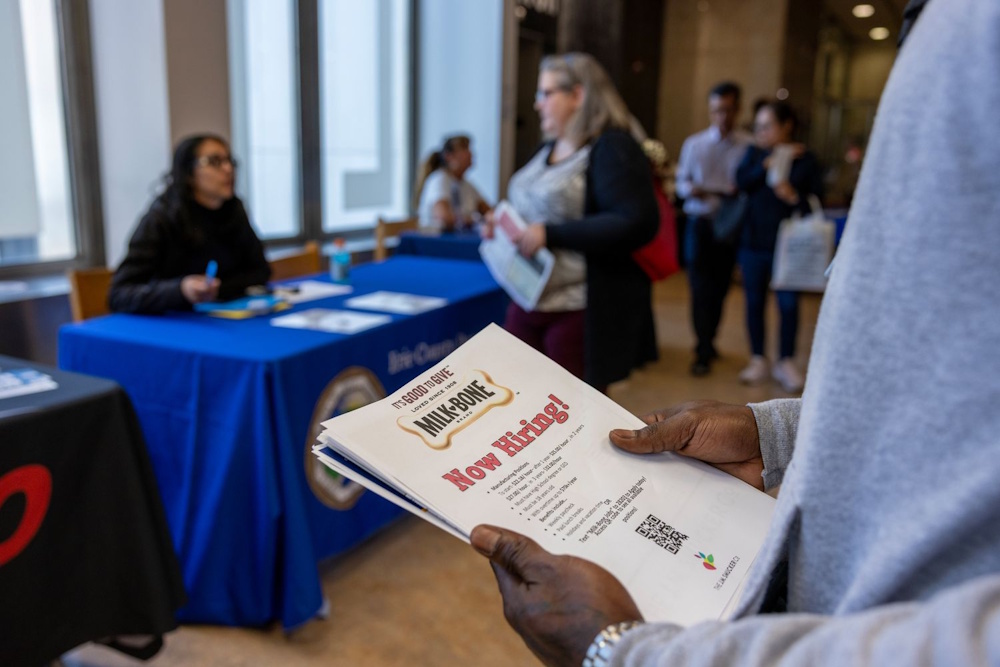
When the latest official jobs report is released on Friday, analysts anticipate that it will indicate an increase in hiring for July, while the unemployment rate is expected to remain unchanged at 4.2%. Economists estimate that monthly employment gains will reach 97,500 jobs, representing an increase from June’s disappointing figure of 57,000 jobs added. The majority of the employment growth observed last month is expected to be concentrated in a single sector: healthcare and social assistance. Friday’s report will likely highlight the stability of the job market, albeit in a low-flow condition, characterised by somewhat sluggish non-healthcare hiring and a largely unchanged unemployment rate. “Low-hire, low-fire” — the well-worn moniker for the current labor market — is certainly catchy but, like most labels, it can’t capture all the inner workings or lived experiences. Americans are navigating a labor market with opportunities for some but not for all, sidelining job seekers and leaving many of the youngest job hunters without the foundational roles and skills needed for their futures. “It’s like a drip feed,” said 18-year-old Scott Konopka of his recent search to land a summer job when he was back home from college. The aviation double-major at Western Michigan University submitted approximately 100 applications to a diverse array of employers offering summer opportunities, encompassing retailers, restaurants, landscapers, and airports. Konopka received three rejection letters, and the remainder was silence. He ultimately contacted the Wendy’s restaurant where he was employed following his senior year to enquire about the availability of any shifts. “I gave up with fighting the job market, and now I’m back doing my old job,” he said.
Certain cohorts — including teen workers — can serve as the proverbial “canary in the coal mine,” sounding the alarm that the labor market or broader economy are potentially unwell. Summer employment typically consists of temporary positions that are entry-level, predominantly found within sectors such as leisure and hospitality. During periods of economic downturn, employers often reduce hiring or prioritise candidates with more experience. Businesses increasingly rely on technology to address labour shortages, while certain consumers may decrease their discretionary expenditures. Earlier this year, the outplacement and labour research firm Challenger, Grey and Christmas issued a cautionary note: Teen summer hiring was expected to decline further from last summer’s already unprecedented low. “We predicted a quiet summer last year, and it played out even quieter than expected. The dynamics that drove that slowdown — cost pressures, automation, employers waiting to see how consumer demand holds up — are all still in place, and in some cases, they’ve intensified,” Andy Challenger said in a statement. The preliminary data from the Bureau of Labour Statistics for June indicates that the teen employment-to-population ratio has reached a nine-month low, while the unemployment rate is trending higher compared to the previous year. “It tells us that employers do not have much appetite for taking on workers either full-time or even temporarily — there’s just not a lot of appetite to expand their workforce,” Kory Kantenga told, adding that the economic uncertainty is weighing on consumers as well. “They’re being more judicious about how they’re spending. That slows down growth. That slows down opportunities in the labor market.”
Teen employment constitutes approximately 3% of the labour market, thus alterations in this segment have minimal impact on the overall headline job figures, as noted by economists. And the slowing in hiring is likely more a reflection of structural and sector-specific pressures rather than a recession warning, the economists noted. Nonetheless, these positions hold significance for young workers in need, as highlighted by the economists at Raymond James. They pointed out that teenagers can acquire essential soft skills—such as communication, teamwork, and responsibility—while gaining a clearer insight into workforce expectations and the everyday realities of various industries. For teenagers such as Ivanka Lopez, the summer job serves as a crucial stepping stone on their career trajectory. Lopez, 15, aspires to become a paediatric anaesthesiologist and is actively engaging in coursework to advance that career path. Concurrently, she requires practical work experience. She has contributed to her family’s restaurant, yet she aspired to forge her own trajectory. Her persistence yielded results, culminating in a summer position at an ice cream and chocolate establishment.
At 15, she encounters certain restrictions regarding working hours and specific machinery, such as a prohibition on entering the freezer. Nevertheless, she has adeptly navigated these constraints: She conveyed a sense of accomplishment in achieving a new training level, where she took on the responsibility of coating various confections in chocolate and caramel. “I find myself building a stronger work ethic that I feel would be good when I have other jobs in life, for school, and building my personality, too,” Lopez told. “I feel lucky and blessed, because as things are right now, it’s really nice to feel like I could support my parents and myself in any way.” Friday’s jobs report could show a labor market that “remains stable, but without much spark,” EY-Parthenon economists wrote in a note to investors on Tuesday. Labour supply remains constrained, with participation rates hovering around post-pandemic lows, as noted by EY-Parthenon economists Gregory Daco and Lydia Boussard. “At the same time, many firms are choosing to retain workers through the uncertainty, relying on a cautious wait-and-see approach, attrition from retirements and resignations, and targeted or performance-based layoffs rather than broad workforce reductions,” they wrote. The supply pressures are arising from a structural shift within the labour market: The population is ageing, Baby Boomers are retiring, and immigration flows have significantly decreased. Hiring patterns are also evolving, according to Nela Richardson. “Employers are reacting to a host of different drivers that’s shifting how they hire throughout the year,” she said. “So, a strong month or a weak month may just be a short-term change in a hiring pattern, rather than a longer-term signal of the outlook for the second half of the year.”
ADP on Wednesday published its most recent assessment of private-sector employment trends, indicating that firms contributed an estimated 44,000 jobs in July. That tally, if it persists, represents the lowest recorded figure thus far this year. Additional data has contributed to a more optimistic perspective regarding the labour market. Jobless claims, a closely monitored indicator of layoffs, have stayed remarkably low. In mid-July, first-time filings for unemployment insurance reached their lowest level since 1969. New Labour Department data released Thursday indicated that approximately 199,000 initial claims (seasonally adjusted) were submitted during the week concluding August 1. The current four-week running average for claims stands at its lowest level since 2022, coinciding with the peak of the post-pandemic job boom. Layoff intentions are also exhibiting a downward trend. In the previous month, employers disclosed intentions to implement 33,429 job reductions. Challenger observed that this represents the lowest monthly total in two years. On Thursday, the Chicago Fed released its latest unemployment forecast, indicating a decline in the jobless rate to 4.1% in July, down from 4.2%. This change is attributed to a reduction in layoffs and a rise in hiring activity. Earlier this week, the Job Openings and Labour Turnover Survey for June indicated a modest increase in hiring and quits, which serves as a measure of employe confidence, while layoffs remained largely stable.