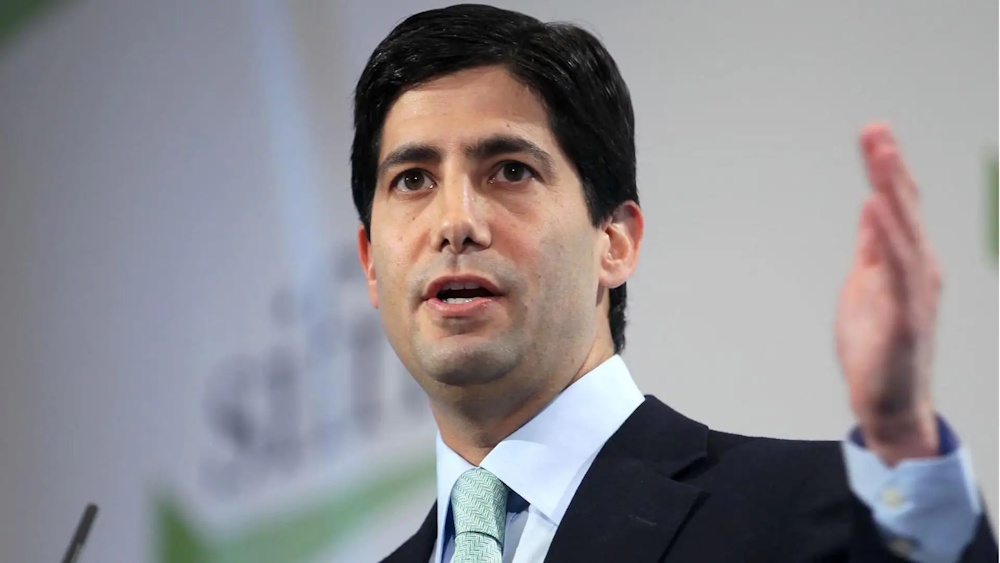
In an effort to combat inflation, which has increased since the beginning of the year as a result of the war with Iran, the Federal Reserve hiked interest rates on Wednesday for the first time in over three years. Officials reached a unanimous decision to increase their benchmark lending rate by a quarter point, adjusting it to a range of 3.75%-4%. That included Chairman Kevin Warsh himself, who was selected by President Donald Trump to head America’s central bank. The Fed’s determination to raise rates highlights its apprehensions regarding inflation, which has remained high for the past five years. A resilient labour market is enabling the Fed to concentrate on inflation. “Today’s policy action will support a timelier return to the Committee’s 2 percent goal,” officials wrote in their latest policy statement. Annual inflation, as measured by the Personal Consumption Expenditures price index, has trended closer to 4% than 2% in recent months. In a post-meeting news conference, Warsh indicated that three factors have shifted since the Fed’s July meeting: The economy exhibited signs of strengthening, inflation remained persistent, and geopolitical tensions escalated. He stated that those were the primary reasons for his vote in favour of a rate hike. “All three of those things helped themselves to a firm, unanimous decision today,” he said. He also stated repeatedly that inflation is the Fed’s top priority.
In the latest economic projections, officials indicated the likelihood of an additional rate hike by the end of the year, aligning with Wall Street’s expectations, and that concludes the analysis. Officials do not anticipate any additional increases in 2027. Warsh again did not submit projections at this meeting, reflecting his ongoing reluctance to provide forward guidance or estimates regarding the trajectory of interest rates. Wednesday’s decision represents the inaugural significant adjustment to interest rates under Warsh, who has consistently asserted his independence in his role as the Fed’s leader. The rate hike may create a divergence between him and Trump, who appointed him following persistent pressure on the central bank to reduce rates. During a conference, Warsh addressed enquiries from journalists regarding inflation, the economic repercussions of the Iran conflict, the bond market, and the potential effects of AI on the US economy, among other topics. Here are the essential insights from the Federal Reserve’s decision to increase interest rates for the first time since July 2023. The Fed’s latest decision follows months of a disruptive war in the Middle East, which has unsettled energy prices and poses a risk of making inflation more persistent and widespread. The Fed’s preferred inflation gauge for August is set to be released later this month; however, an estimate from the Cleveland Fed indicates that it likely increased from August through early September. “There is no hiding from hot spots around the world,” Warsh said. “Our judgment about what is the most likely, or least likely, of the geopolitical situation has changed.”
The Congressional Budget Office in a new estimate released this week said it expects the Iran war to jack up inflation by roughly 0.5 percentage point early next year, citing “inflationary pressures caused by the reduction in shipments of oil and natural gas through the Strait of Hormuz and disruptions to shipping through the Red Sea.” The Fed’s latest policy statement acknowledged the uncertainty generated by the ongoing conflict in Iran, which remains unresolved. When queried by a journalist regarding his views on Trump’s suggestions to reduce borrowing costs, Warsh refrained from expressing agreement or disagreement. Instead, he emphasised the significance of the Federal Reserve’s political independence. “I don’t have anything for you on discussions with the President, and I am not a Wall Street newsletter.” he said. “Part of the independence of the Federal Reserve is we stay in our lane. Independence is a two-way street.” And “We will let people that do trade policy and fiscal policy stay in their lane,” he said. National Economic Council Director Kevin Hassett informed Jake Tapper on Wednesday that the president will accept the Fed’s latest rate hike. The president posted later Wednesday on his social media platform: “LOWER THE INTEREST RATES FOR THE UNITED STATES OF AMERICA, AND FAST!” though he stopped short of criticizing Warsh. Trump has recently rounded on the Fed’s influential Board of Governors, calling them “political” and “hostile.” The Fed’s rate decisions aren’t made by the board itself, but rather by a broader group at the central bank that includes the board.
Warsh emphasised that inflation remains the Fed’s foremost concern, and there are apprehensions regarding the possible inflationary effects stemming from the extensive AI development. He did not explore the influence of AI on pricing dynamics; however, he noted that business investment – significantly propelled by AI – has been characterised as “robust,” a sentiment echoed in the Fed’s policy statement. In response to a question, Warsh said he has “spent a lot of time thinking about AI.” And “We care very much about what is happening in artificial intelligence. We care much about the implications on the demand side of the economy, and ultimately on the supply side of the economy,” he said. “I think it is so important, that we established a task force that should report by the end of the year to help us think about implications for future policy.” One of the five task forces established by Warsh is focused on assessing the potential economic implications of AI. This group includes Charles Jones, an economics professor at Stanford University currently on leave at Anthropic; Asha Sharma, executive vice president and CEO of Microsoft’s Xbox; and Marc Andreessen, co-founder and general partner at the venture capital firm Andreessen Horowitz. Investors are closely monitoring any indications from the chairman that a robust cycle of rate increases may be forthcoming.
In a significant address last month, Warsh remarked that there remains considerable “work to do” in the battle against inflation. The bond market, meanwhile, has already begun to undertake some of the Federal Reserve’s responsibilities, increasing borrowing costs even prior to any rate hike. The yield on the 10-year US Treasury, a crucial indicator of borrowing costs, surpassed 5% once more on Wednesday, marking its highest closing level since 2007. That is exerting pressure on households and businesses. Warsh stated that the increase in yields is indicative of three factors: a robust economy, geopolitical dynamics, and heightened competition for capital. “The economy is strengthening,” Warsh said. “The so-called hyperscalers are out in the market raising funding, so the competition for capital is real, and it partly explains the increase in yields.” He reiterated that the Iran war has resulted in “hot spots around the world” and “what that means for products that find their way into a store across the country.” Currently, the US economy appears to be performing well. Job growth accelerated significantly in August, as reported by the Bureau of Labour Statistics, while the unemployment rate remained stable at a relatively low 4.1%.
Economic growth has maintained a robust trajectory, although a growing proportion of this expansion has been fuelled by fervent investment in AI. New data released on Wednesday indicated that Americans significantly increased their retail spending last month, suggesting that the Federal Reserve has some capacity to raise interest rates. The Fed’s pivot to rate hikes suggests that central bankers are confident the labour market can endure tighter monetary policy. In addition to combating inflation, the Federal Reserve bears the responsibility of maintaining the integrity of the labour market. However, it is not assured that the Fed will avoid unintentionally steering the economy into a recession with each rate hike. Historically, Federal Reserve chairs have proactively induced recessions when necessary to rein in inflation effectively. Warsh presented Wednesday’s rate hike in an optimistic light: The US economy is robust enough to withstand a few rate increases. “Because of the underlying strength of the economy, because we are, as I mentioned, largely acting consistent with full employment, we can be focused on stable prices,” he said.