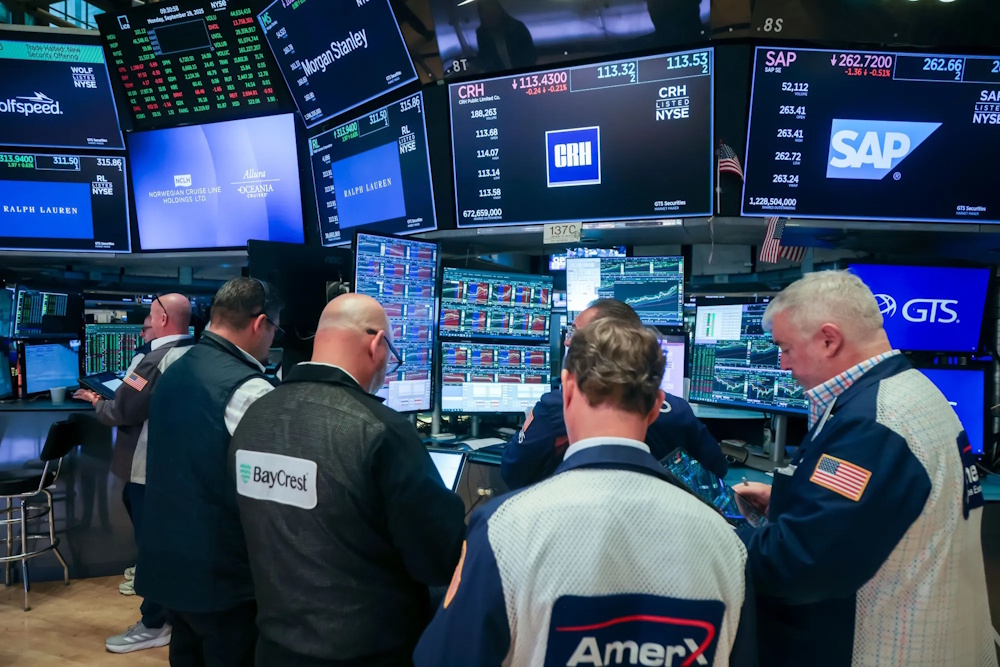
Following Friday’s mixed close, U.S. stocks appear poised for a positive start on Monday, buoyed by a significant decline in oil prices and a resurgence of optimism regarding the robustness of Artificial Intelligence. Concerns regarding tensions in the Middle East persist, despite emerging optimism for diplomatic advancements during this week’s UN meeting. Ahead of a crucial meeting between U.S. President Trump and Gulf-state leaders on the sidelines of the United Nations General Assembly, Trump issued a stark warning to Iran, suggesting that the nation would face economic failure or the potential eradication of its leadership if it did not engage in negotiations. Trump suggested the possibility of a meeting with Iranian President Masoud Pezeshkian in New York, noting that significant developments could occur soon and that he is currently in a “deciding mode” regarding military action, ongoing economic pressure, or a potential agreement.
U.S. futures are exhibiting a robust increase, indicating a positive opening for Wall Street equities. The Dow futures are up 0.87 percent, the S&P futures are up 0.71 percent and the Nasdaq futures are rising 1.1 percent. U.S. stocks exhibited volatility throughout the trading session on Friday, with the major averages oscillating around the unchanged mark before concluding the day with mixed results. While the Nasdaq and S&P 500 concluded the day in positive territory, the narrower Dow recorded a modest loss. The Nasdaq increased by 104.25 points, reflecting a rise of 0.4 percent, reaching 26,522.55. Meanwhile, the S&P 500 saw an uptick of 12.74 points, or 0.2 percent, bringing it to 7,650.50. In contrast, the Dow experienced a decline of 95.40 points, equivalent to 0.2 percent, settling at 51,682.64. For the week, the Nasdaq advanced by 0.7 percent, the S&P 500 edged down by 0.1 percent, and the Dow slumped by 1.7 percent. The tech-heavy Nasdaq exhibited a robust upward movement as the trading day concluded, driven by a rally in semiconductor stocks, with the Philadelphia Semiconductor Index experiencing a notable increase of 2.8 percent.
Broking stocks exhibited robust performance, culminating in a 1.1 percent increase in the NYSE Arca Broker/Dealer Index. Conversely, stocks in the utilities, telecom, and housing sectors, which are sensitive to interest rates, experienced a notable decline. The volatile trading observed today occurred alongside a varied performance in crude oil prices and treasury yields, which have been significant factors influencing trading in recent sessions. The volatile trading observed today occurred alongside a varied performance in crude oil prices and treasury yields, both of which have significantly influenced trading dynamics in recent sessions. U.S. crude oil futures have experienced a significant decline today, retreating beneath the $100 per barrel mark, while treasury yields have demonstrated a robust upward movement during the same period.
Oil prices declined as optimism grew regarding a possible de-escalation of the conflict in the Middle East; however, treasury yields surged in response to persistent concerns about the future trajectory of interest rates. Overall trading activity remained somewhat subdued; however, some traders took a step back to assess the outlook for the markets following recent volatility. On the U.S. economic front, the Fed released a report indicating that industrial production unexpectedly remained unchanged in August, as an increase in utilities output was counterbalanced by a decline in manufacturing output. The Fed reported that industrial production remained stable in August, following an unaltered increase of 0.2 percent in July. Analysts had anticipated a rise in industrial production of 0.3 percent.