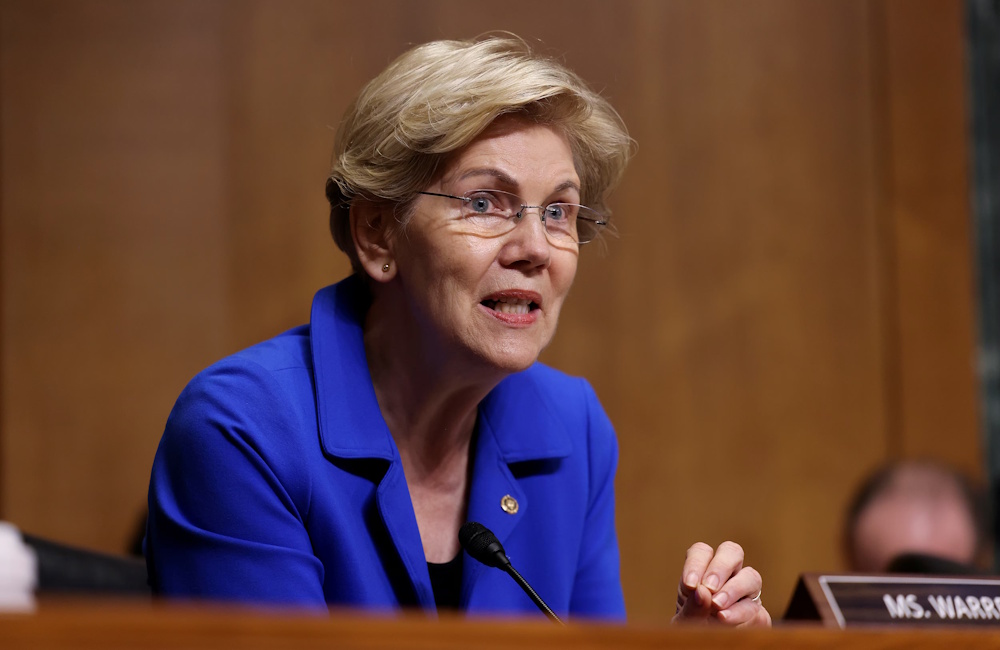
Days before his inauguration in 2025, president-elect Donald Trump undertook an unconventional move: He launched a memecoin. That memecoin experienced a brief surge in value, followed by a significant decline in an extensive selloff that resulted in nearly a million investors confronting losses. Currently, a duo of Senate Democrats is urging the chief regulatory official overseeing Wall Street to conduct an investigation into the situation. Democratic Senators. Elizabeth Warren and Richard Blumenthal are urging the Securities and Exchange Commission to conduct an investigation into Trump’s memecoin “to detect any illegal fraud or unjust enrichment that the coin may have facilitated.” And “We are concerned that President Trump’s memecoin scheme may constitute an illegal scam,” Warren and Blumenthal wrote on Monday to SEC Chair Paul Atkins in a letter. The Trump coin, with 80% of its holdings attributed to Trump Organization affiliates, attained a peak valuation of approximately $9 billion on January 19, 2025. Memecoins, a highly volatile category of cryptocurrency often derived from pop culture and viral phenomena, lack intrinsic value yet can experience significant fluctuations in price, soaring or plummeting dramatically. The TRUMP cryptocurrency paid huge dividends to Trump, who promised to be America’s first crypto president and received enormous support from the industry.
Last year, he generated approximately $636 million in royalty and licensing fees associated with “Celebration Coins,” as detailed in his 2025 annual financial disclosure. Flash forward to today: The Trump coin is valued at under $400 million, with investors who purchased at peak levels facing significant losses nearing 97%, as reported. Nearly 1 million individuals incurred financial losses from the Trump memecoin, accumulating a total of $3.8 billion in losses by the end of June, as reported by research from the crypto analytics firm Nansen. “The SEC must be willing to enforce the law even when potential wrongdoers include those with powerful political connections,” the lawmakers wrote in the letter. The White House directed enquiries to the Trump Organization. The SEC refrained from providing any commentary. Specifically, the Senate Democrats articulated apprehensions that the memecoin initiative might be characterised as a “rug pull.” In the unregulated landscape of cryptocurrency, a rug pull represents a fraudulent scheme in which developers artificially inflate the value of a token before abruptly disappearing with the investors’ capital. By abruptly removing support from investors, the tokens have diminished in value to nearly nothing. In a recent interview, Trump articulated his defence regarding his cryptocurrency profits. He stated that he adhered to the law and permitted his sons to manage his personal finances during his time in office. “I’m a really good business person. I’ve made money. I made a tremendous amount of money, more than I would have ever thought I would have made,” Trump told. “And I let people invest it, I don’t even speak to — I don’t even know who they are, but it’s given to big firms… my son Eric handles it.”
TRM Labs, a blockchain intelligence company, discovered in January 2025 that the significant insider allocation in the Trump memecoin underscores the necessity for “meticulous oversight,” yet the project “does not have the hallmarks of a rug pull.” Ari Redbord, a former federal prosecutor and US Treasury official who is now global head of policy at TRM Labs, stated that the January 2025 analysis remains valid, indicating that the Trump memecoin was not established as a rug pull. “That does not mean it is okay how it has played out,” he said. Redbord highlighted the concentration of this token among a limited group of holders, noting that the erosion of price support occurred gradually rather than abruptly. “A small group of early buyers and the coin’s creator profited. Most of the people who bought in later lost money, and lost it at scale,” he said. “Eighty percent of supply sitting with a small group of investors and close to a million retail buyers absorbing the losses, is going to look worse with time, not better, whether it was a rug pull or not.” Warren and Blumenthal suggested in their letter that the Trump memecoin could be a “soft rug pull,” one where the support is pulled more gradually. There exists a discourse regarding the extent of the SEC’s jurisdiction in probing purported rug pulls within the cryptocurrency sector.
Days prior to Trump’s inauguration in 2025, the SEC filed charges against a blockchain engineer from New York for allegedly engaging in a “rug pull fraud.” However, in late February 2025, weeks into the Trump administration, the SEC issued new guidance that clarified that a memecoin is not a security. “Neither meme coin purchasers nor holders are protected by the federal securities laws,” the SEC said in that guidance. But the SEC also said this guidance does not apply to products that are simply labeled memecoins “in an effort to evade the application of the federal securities laws by disguising a product that would otherwise constitute a security.” In other words, regulators will assess each cryptocurrency individually, considering the unique characteristics and implications of each coin. Warren and Blumenthal contend that Trump’s memecoin serves as a pertinent case for evaluation. “The SEC must investigate whether a fraudulent scheme may be underway, and prevent further extraction of enormous value from the hundreds of thousands of investors who put their faith in Trump’s coin,” the lawmakers wrote on Monday.