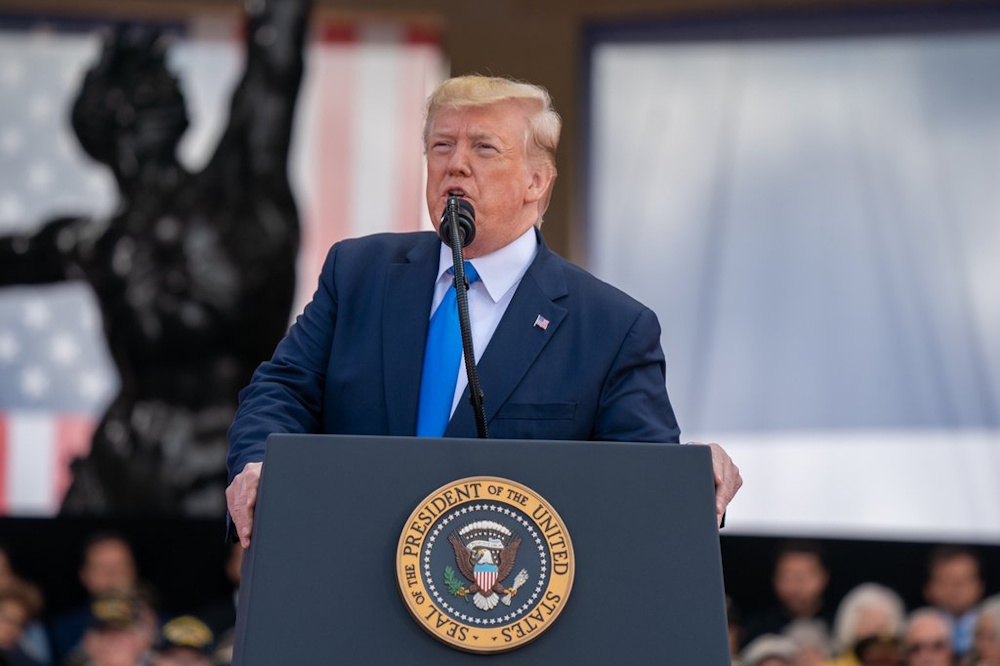
US President Donald Trump stated that negotiations with Iran, expected to take place through intermediaries, are scheduled to commence on Monday. Speaking to reporters aboard Air Force One, Trump confirmed that communication channels were operational. “We are talking to them [the Iranians] in the form of a negotiation; it begins tomorrow afternoon, and we’ll see how it goes. I’d love to do that. It’ll save a lot of lives, a lot of unnecessary power, to be honest with you. We are ready to go whenever we want. Would I rather make a deal? I’m not looking to kill people, because a lot of people die; we don’t want that. So they asked us, Iran specifically, but the other three, they asked us,” Trump said.
The US President disclosed that diplomatic interactions with Saudi Arabia, the United Arab Emirates, Qatar, and Iran prompted him to suspend what was initially intended to be a “massive attack” on Friday. Trump further indicated that an agreement could be reached regarding the management of the Strait of Hormuz, while asserting that an accord would be established concerning the denuclearisation of Iran. The abrupt shift towards diplomatic engagement arises as intermediaries strive to reinvigorate a dynamic framework between Washington and Tehran. Israeli media reports on Sunday indicate that regional intermediaries are working to reinstate a memorandum of understanding signed last month, aimed at keeping the strategic waterway open and free of charge for a duration of 60 days.
Iranian state media similarly indicated that discussions between Iran and Oman concerning a joint operational mechanism to govern the maritime corridor were in their final stages. The initial framework had previously collapsed due to conflicting interpretations, with Trump asserting the passage would remain open permanently, while Tehran maintained the agreement preserved its sovereign control over the trade route. Diplomatic manoeuvres conducted over the weekend were instrumental in preventing an escalation into immediate conflict. Qatari officials conducted extensive discussions with Iran, the United States, and Oman, ultimately notifying Trump on Saturday that Tehran had agreed to a proposal concerning the strait. Simultaneously, Saudi Crown Prince Mohammed bin Salman engaged in a telephone conversation with Trump to advocate against military intervention.
Following these exchanges, Trump announced on Truth Social that he was halting the planned strikes, citing progress on the shipping route and nuclear discussions. Despite the absence of military strikes reported overnight into Sunday, Iranian military leaders dismissed Trump’s characterisation as a “lie.” Additionally, a source affiliated with Tehran’s delegation informed the semi-official Fars News Agency that no formal agreement regarding the strait had been established as of yet. Meanwhile, perspectives among Gulf allies continue to be markedly divergent regarding the appropriate approach Washington should adopt towards Tehran. Source reported on Sunday that while Saudi Arabia advised caution, the United Arab Emirates advocated for a more aggressive military stance from Washington, contending that the Islamic Revolutionary Guard Corps would not change its trajectory without direct US intervention.