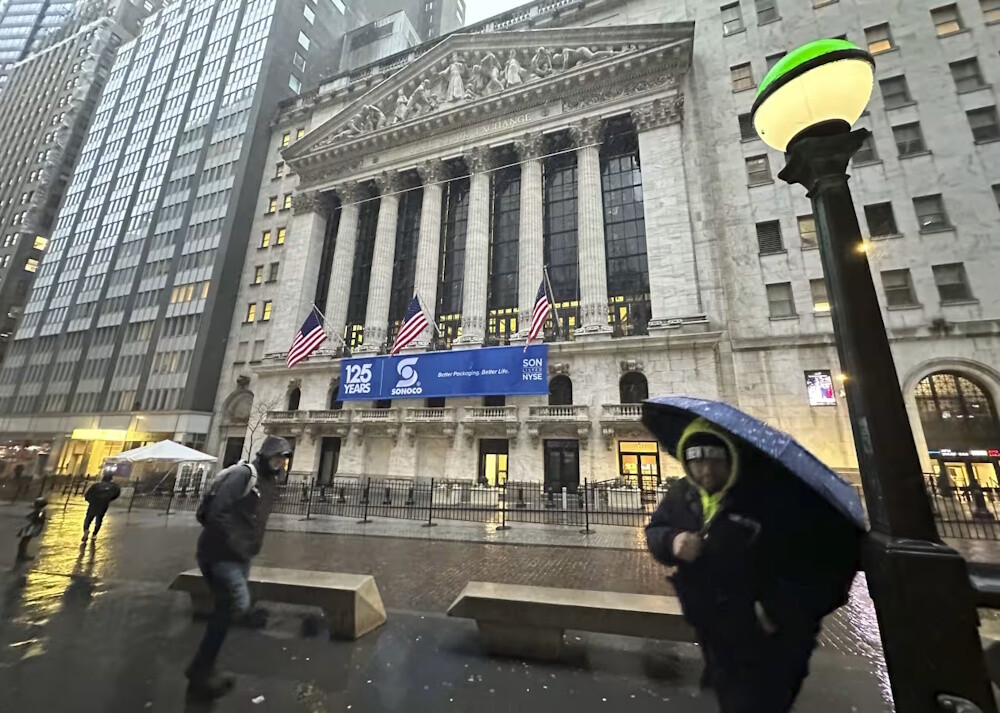
The major U.S. index futures indicated a lower opening on Friday, suggesting that stocks are poised for additional declines following the sell-off observed during Thursday’s session. The major index futures are currently indicating ongoing weakness on Wall Street in early trading on Friday, with the S&P 500 futures declining by 0.4 percent. Lingering concerns regarding the artificial intelligence trade are expected to exert pressure on the markets, compounded by a sustained rise in crude oil prices. U.S. crude oil futures have surged past $100 a barrel, while international benchmark Brent crude oil futures have attained a five-month peak, driven by persistent concerns regarding supply disruptions in the Middle East. However, traders may exhibit caution in making substantial moves in anticipation of several pivotal events next week, including the Federal Reserve’s latest monetary policy meeting.
The Fed is set to announce its latest monetary policy decision next Wednesday, with expectations that the central bank will maintain current interest rates. With a quarter point rate hike still widely anticipated at the Fed’s December meeting, market participants are likely to scrutinise the accompanying statement closely. Earnings news is poised to capture attention next week, as Amazon, Microsoft, and Google parent Alphabet are among the companies set to disclose their quarterly results. “A combination of measured central bank guidance and strong technology results could support a recovery in risk appetite, while hawkish policy signals and disappointing earnings could trigger another round of selling,” said Daniela Hathorn. “With U.S. GDP and PCE inflation also due, investors will have plenty of reasons to reassess interest rate expectations,” she added. “The upcoming U.S. midterm elections on November 3 add another layer of uncertainty, suggesting volatility could remain elevated as markets head into November.”
Following a period of upward momentum in recent sessions, equities experienced a significant decline during Thursday’s trading activity. The tech-heavy Nasdaq experienced a significant decline, falling to its lowest closing level in more than a month. The Nasdaq and S&P 500 concluded the day slightly above their session lows. The Nasdaq experienced a decline of 694.00 points, representing a 2.6 percent drop, closing at 26,008.86. Meanwhile, the S&P 500 fell by 93.74 points, which is a 1.2 percent decrease, ending at 7,663.43. The narrower Dow, conversely, oscillated around the unchanged line throughout the day, ultimately concluding with an increase of 11.89 points, representing a gain of less than a tenth of a percent, at 52,867.98. The sharp pullback on Wall Street occurred as technology stocks faced pressure due to renewed concerns regarding debt-fueled spending on AI infrastructure. Traders exhibit a fluctuating level of concern regarding the artificial intelligence trade, which in turn contributes to significant volatility in the markets. The latest resurgence of worries may be in reaction to comments from Nvidia CEO Jensen Huang, who told that demand for neocloud firms like CoreWeave is “off the charts” but “scarcity of capital” is holding back growth.
A steep drop in shares of Meta Platforms also weighed on the tech sector, with the Facebook parent plunging by 7.1 percent despite reporting third quarter revenues that exceeded estimates and providing upbeat guidance. Once individuals comprehended that Meta must secure substantial funding to maintain its involvement in the AI arms race, their initial excitement regarding the company’s better-than-expected revenue and the swift adoption of its Muse AI agent diminished,” stated AJ Bell head of financial analysis Danni Hewson. Shares of Tesla also tumbled by 3.4 percent after surging by 3.8 percent on Wednesday, despite the electric vehicle maker reporting better than expected third quarter results. The decline observed on Wall Street coincided with a significant rise in crude oil prices, as U.S. crude oil futures surged by over 2 percent. U.S. crude oil futures experienced a notable increase earlier in the day following President Donald Trump’s assertion that the U.S. is not engaged in negotiations with Iran, accompanied by his statement that “something one way or the other” will “happen fairly soon.” A report indicated that the U.S. and Israel have formulated detailed strategies for renewed strikes on Iran following Election Day.
Semiconductor stocks exhibited some of the market’s poorest performances on the day, as the Philadelphia Semiconductor Index declined by 6.7 percent, reaching its lowest closing level in nearly three months. A significant decline in the price of gold has led to considerable weakness in gold stocks, as evidenced by the 5.4 percent drop in the NYSE Arca Gold Bugs Index. Oil service stocks experienced notable weakness, even in the face of rising crude oil prices, resulting in a 3.7 percent decline in the Philadelphia Oil Service Index. Networking and computer hardware stocks experienced significant declines, whereas housing stocks surged in response to a sharp decrease in treasury yields, culminating in a 4.6 percent increase in the Philadelphia Housing Sector Index. Interest rate-sensitive telecom and utilities stocks exhibited notable strength, while pharmaceutical and transportation stocks gained from a rotation away from the tech sector.