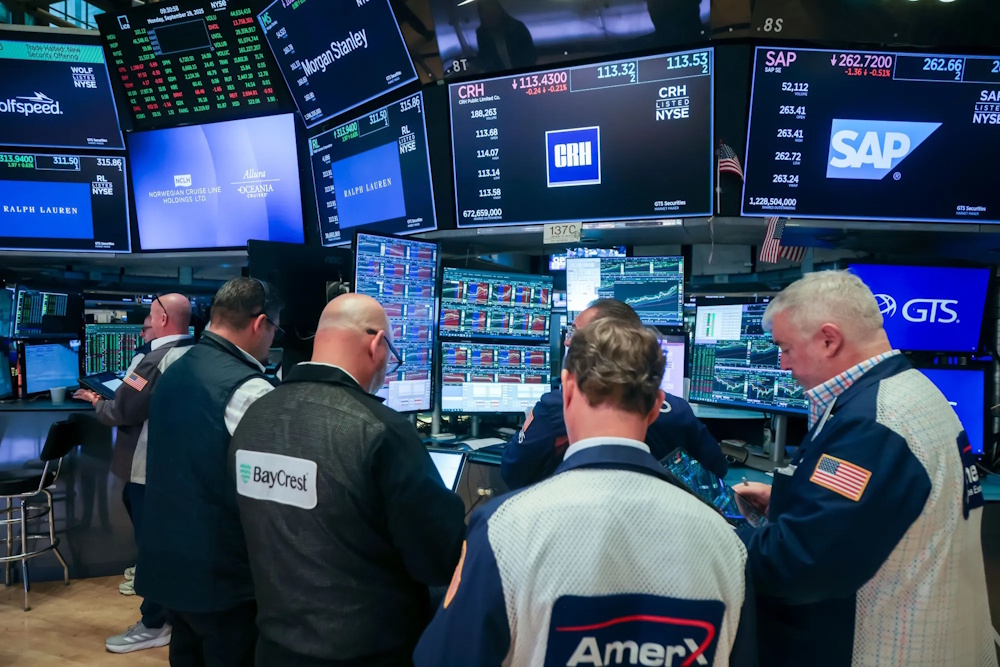
The major U.S. index futures are currently indicating a higher opening on Monday, suggesting that stocks are poised to continue the upward trajectory observed at the end of the previous week. The upward momentum on Wall Street coincides with a significant decline in crude oil prices, fuelled by a resurgence of optimism regarding a resolution to the conflict in the Middle East. U.S. crude oil futures are experiencing a significant decline of nearly 7 percent following President Donald Trump’s announcement on Truth Social regarding the cancellation of a planned military action against Iran. “We have just been asked by Iran, and other Middle Eastern Countries, to hold off any attack in that the perimeters of a deal has been agreed to,” Trump said. “This would include the Immediate, Complete, and Total OPENING OF THE HORMUZ STRAIT, and an end to Iran’s nuclear threat.” He added, “Based on this request, I have agreed, for the future benefit of the WORLD and, likewise, the survival of a successful and prosperous Iran, to cancel the attack, subject to being able to rapidly make a DEAL.”
Buying interest may be somewhat subdued; however, past moves by the U.S. and Iran to halt attacks have been relatively short-lived. Traders might exhibit caution in executing substantial transactions in anticipation of the forthcoming release of the Labour Department’s highly scrutinised monthly jobs report on Friday. Stocks exhibited a lack of clear direction in the early part of the session on Friday, having struggled to maintain an initial upward movement, yet they generally trended higher as the trading day progressed. The major averages all advanced, contributing to the robust gains recorded during Thursday’s session. The major averages experienced a retreat from their peaks as the day drew to a close, yet they sustained a solid positive stance. The Nasdaq increased by 251.68 points, reflecting a rise of 1 percent, reaching a level of 25,373.85. The S&P 500 saw an advancement of 52.09 points, translating to a 0.7 percent gain, bringing it to 7,489.72. Meanwhile, the Dow experienced a climb of 276.97 points, corresponding to a 0.5 percent increase, resulting in a total of 52,485.03.
For the week, the Nasdaq experienced a notable increase of 1.5 percent, whereas both the S&P 500 and the Dow recorded gains exceeding 1 percent. The strength that re-emerged on Wall Street came amid a sharp increase by shares of Amazon, with the online retail giant soaring by 15.3 percent to a two-month closing high. Amazon experienced a significant increase following the company’s announcement of second quarter revenue and cloud growth that surpassed expectations. Buying interest may also have been generated in response to the recent pullback in crude oil prices following an initial spike. U.S. crude oil futures experienced an increase exceeding 1 percent, following a more substantial rise of over 3 percent earlier in the day. This surge was prompted by Iran’s assertion of having attacked two tankers navigating the Strait of Hormuz, which were under U.S. military escort. Meanwhile, traders appeared unfazed by a surge in treasury yields, even as the ten-year yield rebounded to its highest levels since early 2025. Yields surged in response to the significant rise in crude oil prices, alongside remarks from two of the three Federal Reserve officials who supported a quarter-point increase in interest rates during the recent monetary policy meeting.
In a statement elucidating his vote, Minneapolis Fed President Tushar Kashkari remarked that inflation has remained persistently high compared to the central bank’s 2 percent target for over five years. “If inflation remains elevated, in my view, a potential series of small policy moves would be better than waiting and eventually concluding that even bolder actions were necessary,” Kashkari said. He added, “On the other hand, if inflation durably fades, a strategy of small policy steps would allow the FOMC to slow or pause subsequent adjustments without unnecessary impact on the real economy.” Cleveland Fed President Beth Hammack asserted in a distinct statement that the current moment is opportune for the Fed to take action to accelerate the return of inflation to the target rate of 2 percent. “The longer that high inflation persists, the more challenging and costly it can be to bring it back down,” Hammack said. “I preferred to move at our recent meeting because I did not see the current policy stance as appropriately restrictive.”
With Amazon spearheading the ascent, retail stocks experienced a significant upward shift, propelling the Dow Jones U.S. Retail Index up by 6.6 percent to reach a two-month closing peak. Oil service stocks exhibited robust performance in response to the increase in crude oil prices, culminating in a 2.5% rise in the Philadelphia Oil Service Index. Significant strength also emerged among networking stocks, as reflected by the 2.2 percent gain posted by the NYSE Arca Networking Index. Conversely, gold stocks experienced a significant decline in tandem with the price of the precious metal, resulting in a 3.2 percent drop in the NYSE Arca Biotechnology Index. Biotechnology stocks experienced notable declines during the session, as evidenced by the NYSE Arca Biotechnology Index, which fell by 2.9 percent.