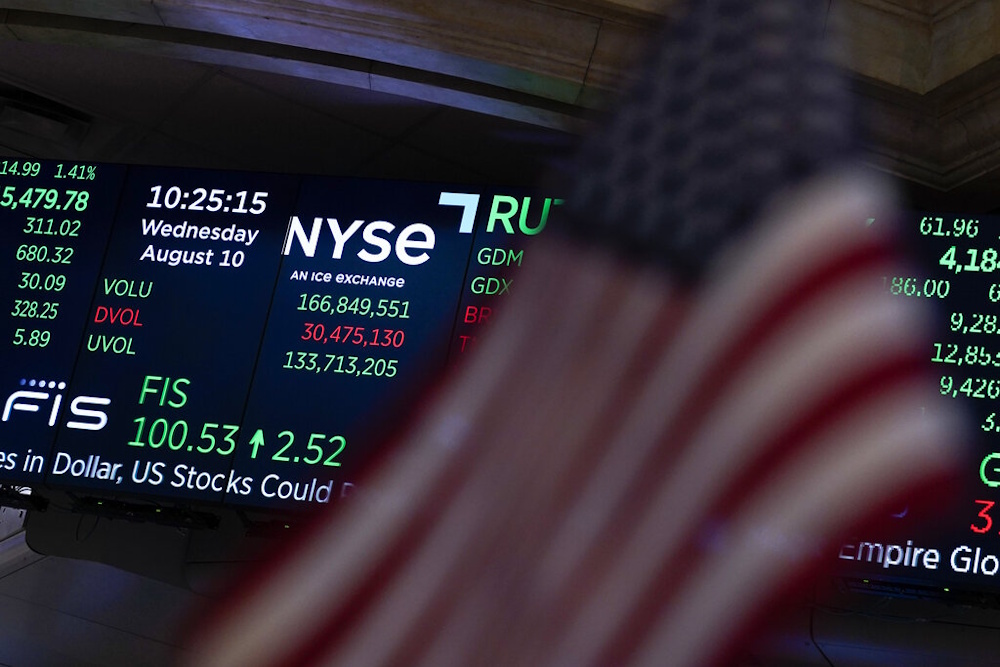
The major U.S. index futures are indicating a higher open on Monday, suggesting that stocks may recover some of the losses experienced during last Friday’s session. Bargain hunting could lead to a rebound on Wall Street after last Friday’s decline, which saw the tech-heavy Nasdaq close at its lowest level in a month. Technology stocks could potentially spearhead the recovery following a significant decline in the prior session, evidenced by the 1.5 percent increase in Nasdaq 100 futures. Shares of Nvidia are surging by 2.6 percent in pre-market trading following the announcement of a multiyear technology partnership with SK hynix. This collaboration aims to advance next-generation memory for the global AI factory buildout and accelerate semiconductor design and manufacturing. Buying interest may be somewhat muted, as apprehensions regarding developments in the Middle East persist, casting a shadow over the markets.
On Sunday, Iran and Israel allegedly engaged in missile strikes, resulting in a surge in crude oil prices due to concerns over a potential re-escalation of the conflict. However, crude oil prices retreated significantly from their peaks following President Donald Trump’s assertion that Israel and Iran are “looking to do an immediate ceasefire.” And “Final negotiations on ‘Peace’ are proceeding, subject to ignorance or stupidity getting in its way,” Trump stated in a post on Truth Social. “The Blockade will remain in place, and in full force and effect, until a ‘Final Deal’ is reached. Things should move quickly.” After facing significant pressure early in the session, stocks experienced an even more pronounced decline throughout the trading day on Friday. The major averages all experienced a significant decline, with the tech-heavy Nasdaq recording a notably steep drop. The major averages concluded the day slightly above their session lows. The Nasdaq experienced a significant decline of 1,121.53 points, representing a 4.2 percent drop, closing at 25,709.43. The S&P 500 saw a decrease of 200.57 points, or 2.6 percent, finishing at 7,383.74. Meanwhile, the Dow faced a reduction of 695.15 points, equivalent to a 1.4 percent fall, ending at 50,886.78. Given the significant declines observed today, the primary indices have all experienced a downward trend over the week.
The Nasdaq experienced a significant decline of 4.7 percent, while the S&P 500 saw a drop of 2.9 percent, and the Dow recorded a slight decrease of 0.3 percent. The decline on Wall Street occurred as technology stocks continued to face challenges following significant weakness observed during Thursday’s trading session. Yesterday’s negative reaction to Broadcom’s guidance continued to generate selling pressure amid concerns about valuations. “The market has moved past questioning the strength of AI demand; that has been largely established,” stated Daniela Hathorn. Investors are increasingly scrutinising the extent to which that growth is already incorporated into valuations. She added, “In that sense, Broadcom’s results may not have been disappointing, but they were perhaps not sufficient to warrant another immediate increase following such a strong rally.” Profit taking played a significant role in the notable decline observed after the recent market strength, which had propelled the Nasdaq and S&P 500 to achieve record closing highs on Tuesday. The Dow concluded Thursday’s session at an unprecedented closing high. A notable rise in treasury yields also impacted Wall Street, as yields soared after the release of robust U.S. jobs data.
The Labour Department released a report indicating that non-farm payroll employment increased by 172,000 jobs in May, following an upward revision to a surge of 179,000 jobs in April. Analysts had anticipated an increase in employment by 85,000 jobs, in contrast to the previously reported addition of 115,000 jobs for the prior month. The data has contributed to ongoing speculation regarding the Federal Reserve’s decision to maintain interest rates at their current level for an extended duration. Semiconductor and computer hardware stocks experienced significant declines, with the Philadelphia Semiconductor Index and the NYSE Arca Computer Hardware Index dropping by 10.3 percent and 9.1 percent, respectively. Outside of the technology sector, gold stocks experienced significant weakness due to a sharp decline in the price of the precious metal, leading to an 8.4 percent drop in the NYSE Arca Gold Bugs Index. Networking, oil service, and software stocks experienced notable declines, whereas utilities and pharmaceutical stocks managed to defy the overall downward trend.