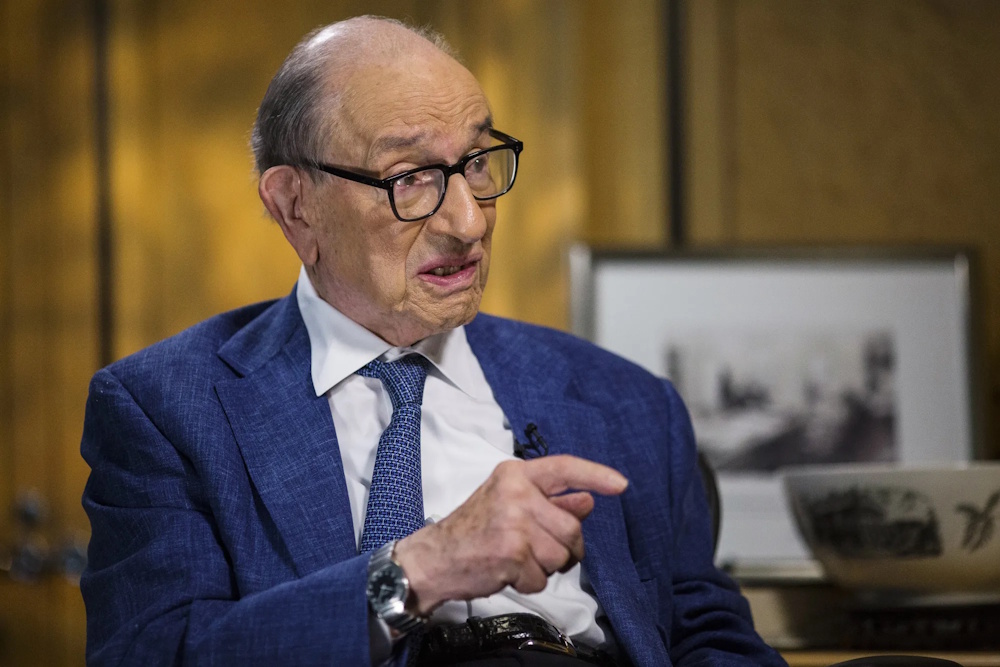
Former Federal Reserve Chairman Alan Greenspan, once celebrated as a maestro for steering a thriving economy, later faced criticism for his role in the housing bust and financial crisis that unfolded after his tenure. His passing has been confirmed by his wife, Andrea Mitchell. He reached the age of 100. Greenspan held the position of Fed chairman for five terms, appointed by four different presidents, beginning with Ronald Reagan, who nominated him in 1987. His term under George W. Bush concluded in 2006. His eighteen-and-a-half year tenure is the second longest in the history of the nation’s central bank. His death was announced in a statement by Mitchell. “Alan passed away at our home this morning at the age of 100 from complications of Parkinson’s Disease,” Mitchell stated. “He was a giant of a man who helped shape the U.S. economy for decades under presidents of both parties, but was always honest in acknowledging his mistakes,” she stated.
Born in New York City, Greenspan taught economics in the 1950s at New York University, his alma mater, while serving as chairman and president of the economic consulting firm Townsend-Greenspan & Co., which he managed for 21 years. He held the position of director of domestic policy research during Richard Nixon’s 1968 presidential campaign and continued to serve as a part-time adviser following his inauguration. In 1974, during the concluding year of the Nixon administration, Greenspan assumed the role of chairman of the President’s Council of Economic Advisers, maintaining this position throughout the duration of President Gerald Ford’s tenure. He resumed his economic consulting work following Ford’s 1976 defeat and maintained this role until his appointment to the Fed. Two months into Greenspan’s tenure, the stock market experienced its most significant one-day percentage drop, as the Dow fell 22% on October 19, 1987, a day that has since been referred to as “Black Monday.” The following day, Greenspan declared that the Fed was prepared “to serve as a source of liquidity to support the economic and financial systems.” His assurance facilitated a relatively swift recovery in the market.
During his tenure at the Federal Reserve, the United States witnessed one of the most robust peacetime economic expansions recorded in its history. Unemployment decreased to below 4%, the equity markets achieved what were then unprecedented peaks, and the federal government transitioned to budget surpluses instead of deficits. Following the collapse of the dot-com bubble in 2000, the economy entered a recession in 2001, which was subsequently exacerbated by the terrorist attacks on September 11. That prompted Greenspan and the Fed to reduce its key interest rate to levels previously unprecedented, ultimately arriving at 1%. Many economists argue that the low rates contributed to the inflation of the housing bubble, incentivising investors to extend mortgages to borrowers who would not have qualified for home loans in the past. Criticism was directed at the Fed for its inadequate oversight of the mortgage market during the exuberant years.
Greenspan dismissed the notion of a housing bubble during his tenure, asserting that although certain local markets may have been overpriced, there was no indication of a nationwide bubble. However, when home values plummeted across the country and foreclosures along with bank failures surged in the autumn of 2008, he stated before the House Oversight Committee that he was in a “state of shocked disbelief.” He stated that although he had attempted to caution regarding the riskiness of certain home loans, the economic repercussions resulting from the collapse of the bubble had “turned out to be much broader than anything I could have imagined.” He subsequently asserted that the low interest rates established by himself and the Federal Reserve did not instigate the housing bubble or the subsequent crisis, and he maintained that he had been correct 70% of the time during his tenure.