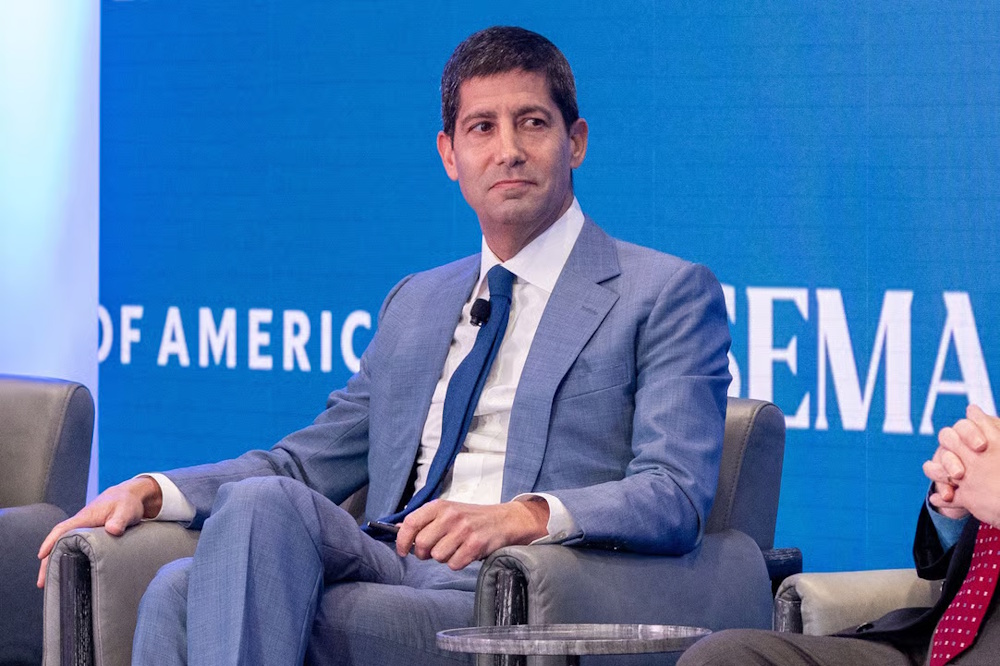
Federal Reserve Chairman Kevin Warsh has pledged “regime change.” On Wednesday, following his inaugural policy meeting, he unequivocally conveyed his seriousness. Under the new Fed chairman, officials voted Wednesday to maintain interest rates at their current level for the fourth consecutive meeting, keeping the benchmark lending rate within a range of 3.5% to 3.75%. Federal Reserve officials suggested a possible increase in interest rates later this year in response to the recent inflation surge associated with the conflict in Iran, as indicated by their most recent economic forecasts. During his initial post-meeting news conference, Warsh declared the establishment of task forces “in each of five areas that are central to the broad conduct of monetary policy.” Warsh, who has consistently expressed disapproval of central bankers’ habit of issuing projections on a quarterly basis, refrained from submitting his own. That was just one of many differences observed in this Fed meeting: The Fed’s policy statement underwent a revision and is now considerably more concise; Warsh’s news conference was also somewhat briefer, particularly in comparison to those held by his predecessor; and further changes appear to be forthcoming.
Warsh stated that the subjects the task forces will be addressing “are timely, consequential, and worthy of a fresh look,” further noting that he was “enlisting some of the very best minds, both inside and outside the economics profession.”
The five task forces will concentrate on:
- Fed communications, including a reevaluation of the Fed’s quarterly Summary of Economic Projections, indicate the anticipated short-term interest rates as projected by individual policymakers at the Fed.
- The Federal Reserve’s balance sheet
- The central bank’s “use and reliance on existing data sources.”
- “Productivity and employment in a time of change”
- The Fed’s inflation framework.
Warsh indicated that the majority of the committees are expected to conclude their activities by year-end, with a clear mandate: to begin with fundamental principles, pose challenging enquiries, scrutinise existing practices, explore alternatives, and ultimately recommend subsequent actions for policymakers’ deliberation. Warsh has already suggested a reduction in the frequency of news conferences: “My mentor’s mantra was press conferences are useful; but when you have one, you want to make sure you have something important to say,” he conveyed to reporters. Warsh indicated that he and his colleagues reached a consensus during this meeting to refrain from providing “forward guidance,” or any indication regarding the potential trajectory of interest rates. He stated that “was not well-suited to the current policy conjuncture.” It represents a significant shift from the operational approach of the Federal Reserve under former Chair Jerome Powell, who actively provided markets with forward guidance. Warsh reiterated that he and his colleagues “will deliver price stability.” And “We possess the necessary capability and unwavering commitment to achieve our price stability objective of 2%,” he stated. “The commitment to deliver is strong, unanimous, and unambiguous. And that’s an important message we’ve missed for five years. And we’re going to fix that.”
Several of Warsh’s colleagues have already expressed concerns regarding inflation, placing the new Fed chief in a challenging position. President Donald Trump appointed Warsh to cut rates, yet it appears that nearly every member of the Fed’s rate-setting committee of 12 anticipates either raising rates for the first time since 2023 or maintaining the current levels. Only one official anticipates a reduction in rates this year. Warsh refrained from providing further details beyond what was conveyed in the projections and policy statement. For officials to increase rates, they must observe price pressures extending significantly beyond the energy sector to justify such a move. Thus far, this has not occurred, as “core” inflation metrics, which exclude the more volatile energy and food prices, have risen at a more moderate pace in recent months. Inflation may indeed decrease significantly if the peace agreement between the United States and Iran remains intact, thereby fully reopening the Strait of Hormuz, a crucial passage for one-fifth of the global oil supply. Officials anticipate implementing a solitary rate reduction in 2027, which would maintain current rates, assuming a potential increase occurs later this year.
Warsh indicated that he has already engaged in discussions with the Fed’s inspector general, Michael Horowitz, regarding his assessment of the central bank’s current $2.5 billion renovation project for its headquarters in Washington, DC. He stated that a report assessing any abnormalities or mistakes in the planning and execution of the project is expected to be released sometime this summer. Trump and his allies have consistently condemned the project, asserting that the cost overruns indicate mismanagement, as part of their strategy to exert pressure on Powell. The Justice Department initiated an investigation into the matter; however, it was closed earlier this year and subsequently referred to the Inspector General. The ongoing review of the project is precisely why Powell remains at the Fed, despite the customary practice for the Fed chair to step down entirely upon completing their term in leadership. Warsh expressed his anticipation regarding the potential actions the central bank might undertake to “be good stewards of taxpayer money and make sure that we’re delivering on the promises that we made.” The Federal Reserve operates as a self-sustaining entity, nonetheless. And the renovation is financed through its own earnings, not taxpayer dollars.