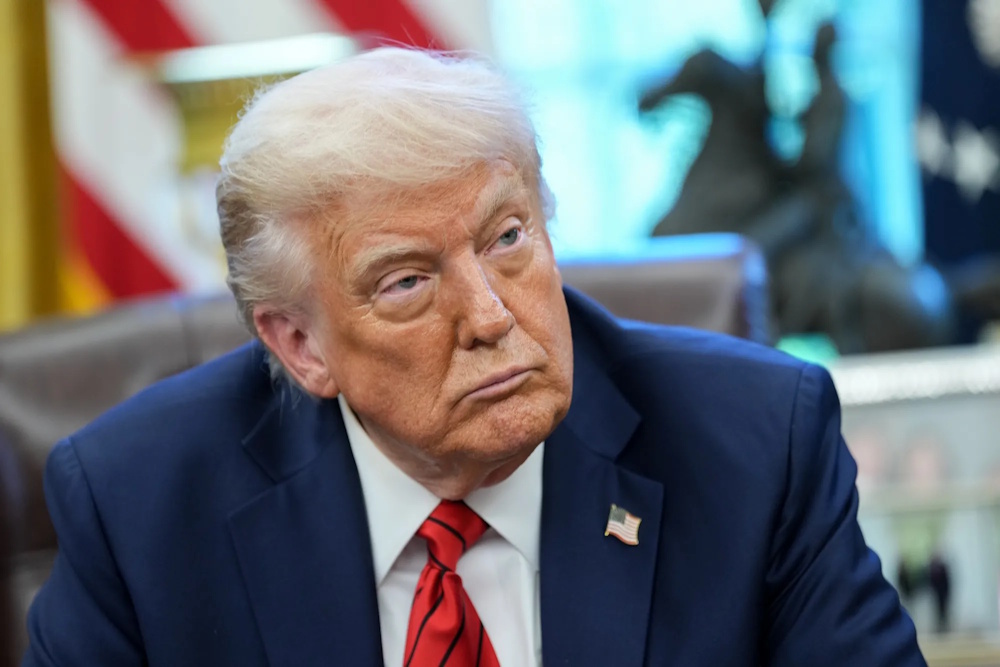
President Donald Trump asserts that ‘Big Oil’ companies are maintaining petrol prices at artificially elevated levels, reflecting a grievance previously voiced by former President Joe Biden during the last surge in petrol prices. However, in contrast to Biden, Trump expresses a desire for the Justice Department to conduct an investigation. In a post on Truth Social early Wednesday, Trump contended that petrol prices are not declining at a sufficient rate, notwithstanding the decrease in oil prices. “The big Oil Companies are not reducing their prices at the pump in line with the significantly lower costs they are incurring for Oil,” he said. “Those prices are dropping like a rock! In other words, customers are being ‘gouged.’ I have instructed the DOJ to immediately start looking into this. Gasoline prices better start going down a lot faster than what I’m seeing!” If that resonates in any way, it is due to its familiarity. Biden expressed a comparable grievance in 2022 when the invasion of Ukraine by Russia resulted in a significant increase in energy prices. “Oil prices are decreasing, gas prices should too,” stated his post in March of 2022, at a time when prices were escalating towards a record high.
“Last time oil was $96 a barrel, gas was $3.62 a gallon. Now it’s $4.31. Oil and gas companies shouldn’t pad their profits at the expense of hardworking Americans.” The challenge for Trump, and for Biden back in 2022, is that retail petrol prices are not determined by “Big Oil.” Prices are determined by tens of thousands of petrol station owners, who operate as small, independent businesses and primarily set their prices according to the wholesale cost of petrol. Oil and wholesale petrol prices are not directly determined by oil companies. They are predominantly determined by international commodity markets. That is why, despite the relatively small amount of Russian oil in 2022 or oil from the Persian Gulf reaching American petrol tanks this year, the disruptions in the oil and petrol markets continue to impact prices in the United States.
Trump is accurate in stating that retail petrol prices have been sluggish in their decline. However, this phenomenon is a persistent characteristic of the market, rather than definitive proof of price gouging. Petrol station owners experienced a contraction in their profits due to a surge in wholesale prices that escalated during the initial months of the conflict in Iran. Some even sold fuel at a loss to prevent pricing their petrol higher than competitors who had acquired wholesale petrol at lower prices a few days prior. When wholesale prices begin to decline, retailers frequently exhibit a lag in reducing their pump prices. They must account for the elevated prices they have already incurred for inventory acquired at increased costs. and are also attempting to recover some of the funds they lost during the period of rising prices.
That is a significant reason why the industry has historically characterised petrol prices as ‘going up like a rocket and coming down like a feather’. In other terms, prices do not decline precipitously, as Trump (and consumers) would prefer. It is not a conspiracy. It pertains to the field of economics. However, attributing the discomfort experienced by consumers at the pump to “Big Oil” is significantly simpler than elucidating the intricacies of global commodity trading or the pricing strategies employed by local stations. Trump is not the first president to assign blame when petrol prices emerge as a political issue. It is probable that he will not be the final individual in this context.