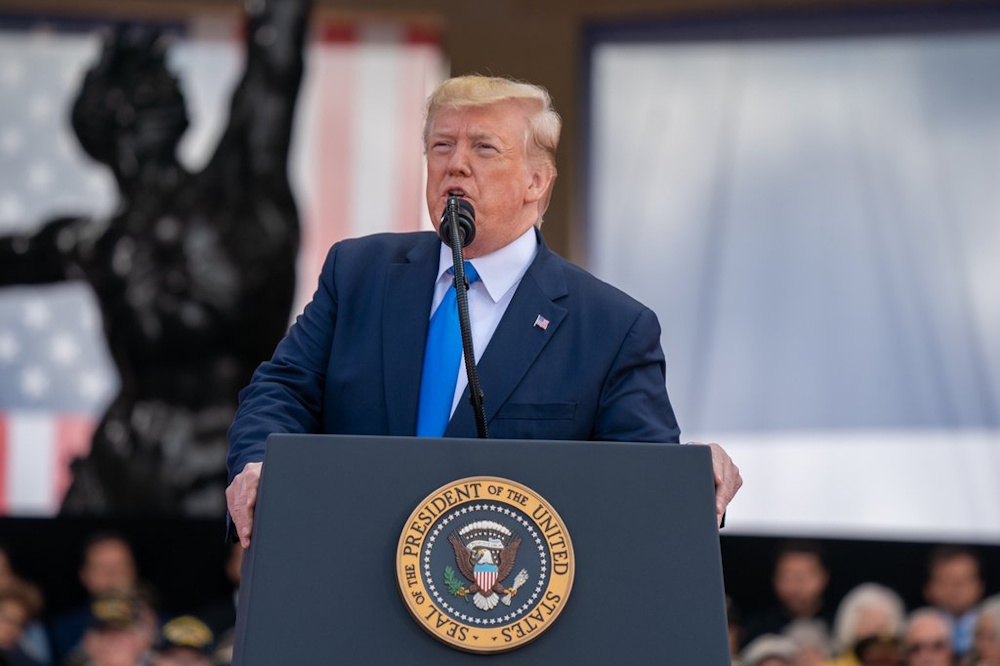
The major U.S. index futures indicate a significantly lower opening on Thursday, suggesting that stocks are poised to relinquish gains following substantial increases in the preceding two sessions. Renewed concerns regarding the potential escalation of the conflict in the Middle East are expected to exert pressure on Wall Street in the aftermath of President Donald Trump’s primetime address on Wednesday night. Trump’s speech largely mirrored his recent comments and posts on Truth Social; however, traders appear to be reacting unfavorably to the tone of his remarks. The president reaffirmed his assertion that the conflict will conclude “very shortly,” while also indicating that the U.S. intends to strike Iran “extremely hard over the next two to three weeks,” aiming to return the nation “back to the stone ages where they belong.” Trump reiterated his appeal for other nations to “build up some delayed courage” and assert control over the crucial Strait of Hormuz, asserting, “The hard part is done.” Following a significant decline over the previous two days due to optimism regarding a resolution to the conflict, crude oil prices have surged in response to Trump’s speech, with U.S. crude oil futures experiencing an increase of over 11 percent.
“Investors did not receive the anticipated outcomes from President Trump’s address to the American populace and have responded in kind,” stated Russ Mould. He noted that uncertainty is notoriously detrimental to the markets, and given the conflicting messages from Trump, the disputed claims from both sides, and the absence of a clear plan to resolve the conflict, the markets are currently facing significant uncertainty. Equities experienced a predominantly upward trajectory during Wednesday’s trading, building on the significant advancements recorded in Tuesday’s session. The major averages experienced upward movement, with the technology-focused Nasdaq achieving a notable increase. The major averages retraced some of their earlier gains during afternoon trading following a morning rally, yet they maintained a solidly positive stance. The Nasdaq increased by 250.32 points, representing a rise of 1.2 percent, reaching a level of 21,840.95. The S&P 500 advanced by 46.80 points, or 0.7 percent, to settle at 6,575.32. Meanwhile, the Dow experienced an uptick of 224.23 points, equivalent to 0.5 percent, concluding at 46,565.74.
The prolonged rally on Wall Street occurred in the context of growing optimism regarding a resolution to the U.S. conflict with Iran, spurred by recent statements from President Donald Trump. During a briefing at the White House on Tuesday, Trump indicated that he anticipates U.S. military forces will exit Iran within “two or three weeks.” The president contended that the United States is not required to achieve a negotiated settlement to conclude the conflict with Iran, deeming a deal “irrelevant” due to the assertion that “everything’s been bombed out.” Trump later asserted in a Truth Social post this morning that Iran’s “new regime president” has requested a ceasefire, which he indicated the U.S. would contemplate when the Strait of Hormuz is “open, free, and clear.” In response to Trump’s post, a report indicated that an Iranian official explicitly denied any request from Tehran for a ceasefire.
Gold stocks continued their upward trajectory from Tuesday as the price of the precious metal surged, resulting in a 4.3 percent increase in the NYSE Arca Gold Bugs Index. Significant resilience was evident in the airline sector, as the NYSE Arca Airline Index experienced an increase of 2.8 percent. The semiconductor, networking, and computer hardware sectors exhibited notable strength, playing a crucial role in the rise of the tech-heavy Nasdaq. Steel, financial, and pharmaceutical stocks exhibited notable upward movements, whereas energy stocks faced downward pressure due to the significant decline in crude oil prices.