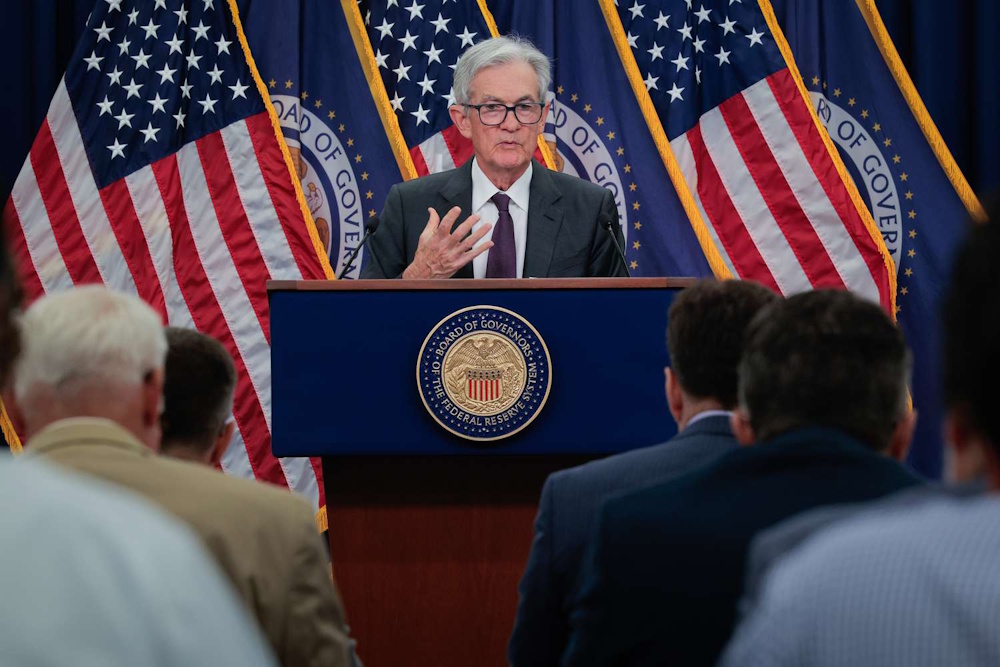
After eight years across three administrations, 66 meetings dedicated to interest rate decisions, a pandemic, a criminal investigation, and numerous criticisms from the Trump administration, Jerome Powell concluded his final policy meeting as chair of the Federal Reserve on Wednesday. However, his departure will not be extensive: Although Powell’s tenure as chair concludes on May 15, he will remain on the Fed’s rate-setting committee, fulfilling a simultaneous term as governor. Powell stated on Wednesday that he deemed it essential to remain in his position until the recently concluded Department of Justice investigation into his actions “is well and truly over with transparency and finality.” The choice to remain, although unusual for a departing chair, echoes Powell’s leadership, during which he has been staunchly committed to safeguarding the central bank’s autonomy. This has remained the case even when it necessitated resisting pressures from politicians across the political spectrum and causing unease among investors. “I have a job that I’m sworn to do, and all I think of is how much people rely on us to get it right,” Powell stated during congressional testimony last year. “It is a challenging role, yet it is one we have embraced with intention.” When queried on Wednesday regarding how he wishes his tenure at the Fed to be perceived, Powell remarked to reporters that it is “someone else to say.” That is a reasonable perspective. Here are several indicators that reflect the impact of his tenure.
Powell convened an emergency monetary policy meeting on March 3, 2020, in response to the escalating number of coronavirus cases. In the inaugural emergency meeting following the 2008 global financial crisis, officials implemented a reduction in interest rates by half a percentage point. “We acknowledge that a reduction in rates will not diminish the rate of infection. It will not rectify a disrupted supply chain. We understand that. “We don’t think we have all the answers,” he stated. However, more accommodative rates could potentially enhance certain sectors of the economy. Fewer than fourteen days later, he called for a second emergency meeting, this occasion occurring on a Sunday. The Federal Reserve reduced interest rates by a complete percentage point, bringing them close to zero. “With minimal forewarning, economies globally experienced a sudden halt. Critical financial markets were on the brink of collapse. “The prospect of an extended, profound global depression was evident,” Powell reflected during a commencement address at Princeton University last year. “Everyone turned to the government, and to the Federal Reserve in particular as a key first responder.” Veteran career civil servants at the Fed, experienced in navigating past crises, asserted their confidence by stating, ‘We got this,’” Powell remarked to graduates at his alma mater. A nascent economic recovery, a wave of stimulus money, and still-malfunctioning supply chains have begun to exert upward pressure on post-pandemic inflation. The Federal Reserve exhibited caution in increasing interest rates as a response to rising inflationary pressures. Powell contended that inflation was “transitory” and that as the economy normalized, the pace of price increases would decelerate.
In November 2021, Powell informed senators that “it’s probably time to retire ‘transitory.’” Three months later, the Federal Reserve increased interest rates by a quarter-point. Nevertheless, inflation reached a peak not seen in four decades shortly thereafter. The situation compelled the Federal Reserve to implement decisive measures. In a notably succinct address to participants at the Kansas City Fed’s Jackson Hole Symposium in August 2022, Powell cautioned that households and businesses were likely to endure “some pain” as the central bank persisted in increasing borrowing costs. “These represent the regrettable expenses associated with curbing inflation.” Powell stated in the address “But a failure to restore price stability would mean far greater pain.” Investors drove the Dow Jones Industrial Average down by 1,000 points, representing a decline of 3%. At the Fed’s next meeting, central bankers raised rates by three-quarters of a point, an unusually large hike compared to traditional quarter-point moves. In November 2017, Trump characterized Powell as “strong, committed and smart” upon his nomination. “And if he is confirmed by the Senate, Jay will put his considerable talents and experience to work leading our nation’s independent central bank,” Trump stated at a Rose Garden event.
Fewer than twelve months later, with the Federal Reserve initiating interest rate hikes, Trump altered his position. He began to critique Powell, despite the fact that the Fed chair has consistently been merely one of the 12 officials participating in the decision-making process regarding rates. During his second term, Trump intensified his derogatory remarks, labeling opponents with terms such as “Mr. Too Late,” “a complete moron,” “major loser,” “fool,” “truly one of the dumbest,” and “numbskull,” among others. Powell remained largely silent until the Department of Justice under Trump initiated a criminal investigation into him concerning his congressional testimony about the central bank’s multibillion-dollar renovation project. The investigation compelled Powell, typically characterized by his apolitical stance, to assert a position against Trump. “This is about whether the Fed will be able to continue to set interest rates based on evidence and economic conditions or whether instead monetary policy will be directed by political pressure or intimidation,” Powell stated in a highly unusual video statement released following the news of the criminal inquiry. Powell also supported Fed Gov.
Lisa Cook in a Supreme Court case that will ascertain whether Trump possesses the authority to dismiss her over alleged – yet unproven and uncharged – mortgage fraud. “That case is perhaps the most important legal case in the Fed’s 113-year history,” Powell stated to reporters in January, emphasizing the significance of the Fed’s independence. Powell has frequently shared insights regarding his journey to what is arguably the most influential role in global economics. He has expressed openly that he never foresaw embarking on a career in economics. He informed Princeton graduates that he disregarded his parents’ recommendation to pursue a major in it, as he perceived it to be “boring and useless.” He lacked a strategy for post-graduation and ultimately found himself “putting labels on shelves in a warehouse for six months,” he stated. “I did not possess a favorable sentiment regarding that.” One message he has consistently underscored is the importance of integrity. “Integrity is priceless,” Powell stated in a 2024 “60 Minutes” interview. “Ultimately, that is all one possesses.”