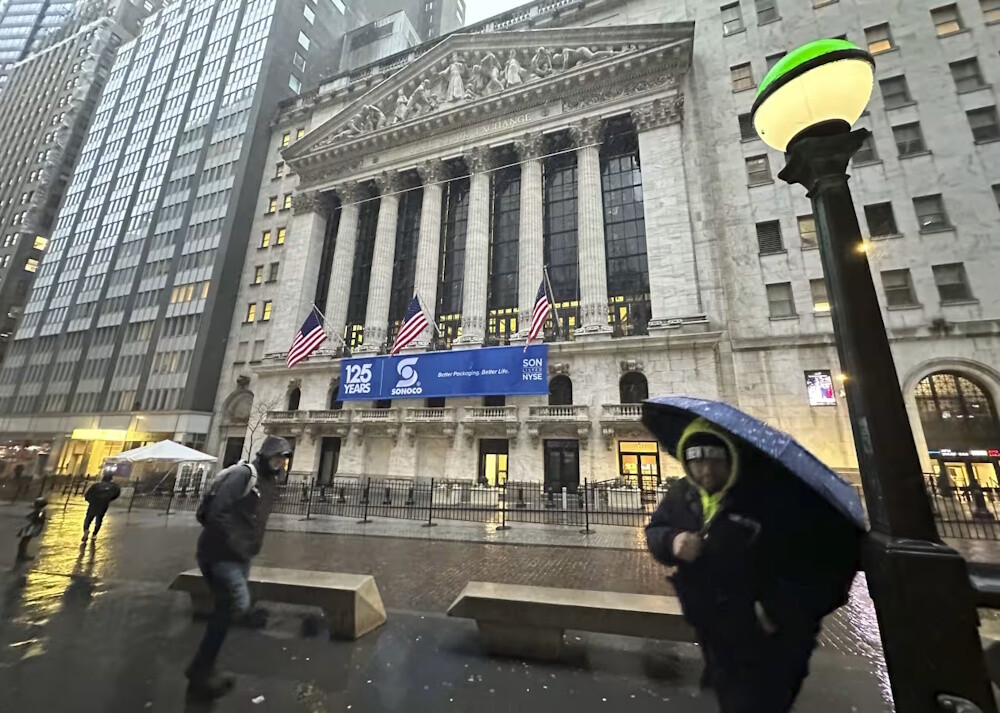
The major U.S. index futures are pointed to a sharply lower open on Wednesday, with stocks likely to see initial weakness following the mixed performance seen on Tuesday. Ongoing weakness in technology stocks is expected to exert pressure on Wall Street, as evidenced by the 3.2 percent decline in the tech-heavy Nasdaq 100 futures. Lingering concerns regarding the artificial intelligence trade may be contributing to the selling pressure observed in the technology sector, particularly in the wake of recent volatility. Shares of AI giant Nvidia are plunging by more than 6 percent in pre-market trading, while shares of Claude developer Anthropic are tumbling by more than 5 percent. “Jensen Huang’s return to Nvidia removed an immediate source of uncertainty and helped lift the Nasdaq 100 nearly 7%, but Tuesday’s losses and softer futures show that investors are reluctant to treat one powerful session as a turning point, with the index having given back a meaningful portion of the rebound,” said Daniela Hathorn.
“The issue is broader than Nvidia’s leadership,” she added. “Its shares fell back on Tuesday, while questions about AI spending, valuations and the returns companies can earn on their investment remain unresolved.” Following a notable increase the previous day, Wall Street relinquished a portion of those gains on Tuesday, even as it remains considerably lower for the month in the wake of last week’s severe selloff. The markets opened in negative territory; however, the Dow swiftly recovered and remained in positive territory for the majority of the session. The S&P and Nasdaq, however, continued to languish in negative territory. The Dow increased by 423.39 points, representing a rise of 0.9 percent, concluding at 50,018.70. In contrast, the Nasdaq experienced a decline of 356.02 points, or 1.5 percent, finishing at 23,733.54. Meanwhile, the S&P 500 saw a decrease of 36.08 points, equivalent to 0.5 percent, ending at 7,201.09.
The weakness that emerged on Wall Street was fuelled by the technology shares on the Nasdaq amid renewed concerns about spending on AI infrastructure and prospects of tighter regulations. Following a significant increase attributed to Nvidia’s reinstatement of CEO Jensen Huang, the company’s shares experienced a decline of nearly 8 percent on Tuesday. This drop was driven by apprehensions that Huang’s return might lead to possible challenges stemming from national security enquiries. Investors expressed concern following remarks from New York Federal Reserve President John Williams, who indicated that inflation continues to be unacceptably elevated at approximately 3.50 percent and emphasised the necessity for monetary policy to facilitate a return to the 2.00 percent target.
Williams indicated that he would not dismiss the possibility of increasing rates at consecutive Federal Reserve meetings, if deemed necessary. Following the increase of rates to the 3.75 to 4.00 percent range in September, the U.S. Federal Reserve maintained these rates in October. According to CME Group’s FedWatch Tool, investors are currently assigning a 95.8 percent probability to a 25-basis-point interest rate increase at the forthcoming Federal Reserve meeting on December 8-9. The probability of a half-point increase is currently assessed at 4.2 percent. On the U.S. economic front, a report released by the Conference Board indicated that the U.S. consumer confidence index surged to 103.3 in November, up from a revised 91.9 in the preceding month. The score was anticipated to register at 92.25 for November.