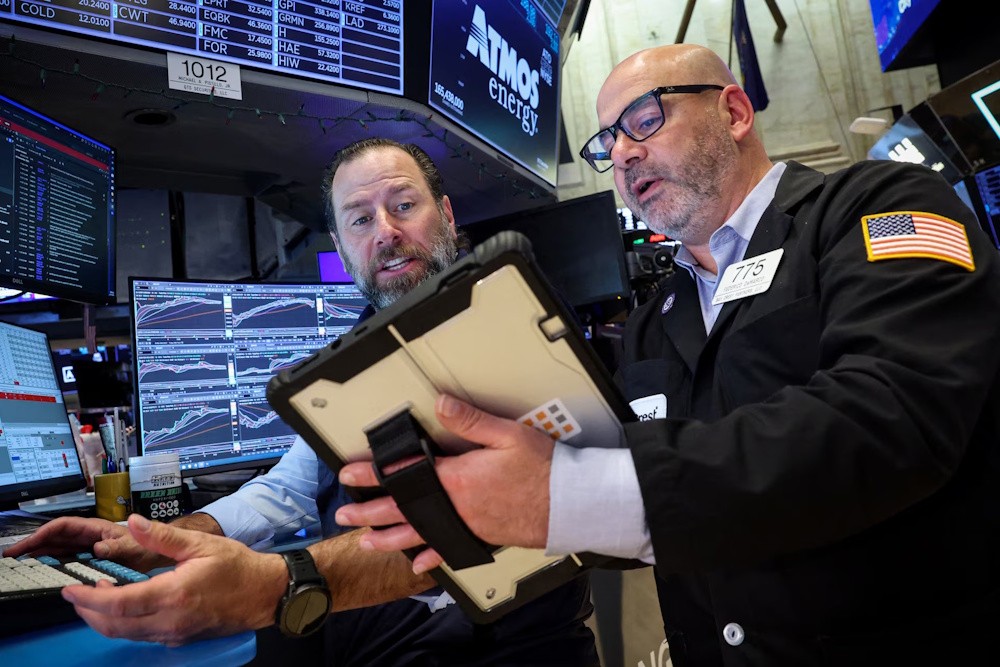
A significant decline in technology stocks escalated on Friday, erasing the Nasdaq Composite’s annual gains, as investors persistently withdrew capital from the previously thriving AI sector. The S&P 500 declined by 3.7%, marking its seventh consecutive day of losses – the longest such streak since February 2020, when financial markets began to prepare for the impending Covid pandemic. The tech-focused Nasdaq experienced a significant decline on Friday, falling by 5.28%. It has experienced a decline of over 2% year-to-date. The Nasdaq reached a historic peak on October 6, reflecting an increase of as much as 18.7% year-to-date. Since reaching its all-time high, the index has experienced a significant decline, wiping out those gains and resulting in a loss of approximately $8.7 trillion in market value. “It’s a meltdown right now,” Arun Sundaram told. “So much bearish sentiment around tech and AI.” Even Anthropic’s blockbuster market debut quickly lost its lustre Friday, with shares in the AI lab declining by 8.5%. They closed at 88.91, just above the company’s IPO of 83. The Dow declined by 950 points, representing a decrease of 1.93%, marking its fifth consecutive day of losses exceeding 1%. The Dow experienced a decline of 8% this week, marking its most significant weekly drop since March 2020.
The Dow and the S&P 500 concluded the trading session on Friday in a state of correction, having declined over 10% from their respective highs recorded on August 5 and October 6. They join the Nasdaq, which recently entered correction territory earlier this month and is currently down 18% from its peak on October 6. Meanwhile, the Nasdaq and S&P 500 experienced their most significant decline since early April 2025, a period marked by President Donald Trump’s tariff proposals that unsettled global markets. Stocks linked to the AI sector have experienced a significant downturn over the past several weeks. With Anthropic’s highly publicised IPO now behind us, traders’ apprehensions regarding the wider industry are once more taking center stage. “There is a real exodus out of tech stocks,” Steve Sosnick told. “Buy the dip has been taking a back seat to sell the rally – or just sell.” And “The tech sector is just getting walloped,” Sosnick said.
Investors are contending with a multitude of concerns, ranging from the implications of newly elected Democratic governors on the momentum of data center construction to the future of Nvidia’s influence in driving the growth of the AI sector following the resignation of CEO Jensen Huang. “There is a fear that maybe there is too much froth and enthusiasm in the tech bet given all the risks out there,” said David Kelly. Kelly noted that corrections are “inevitable” and there is “nothing particularly ominous” about a correction given how much US stocks have rallied in recent years. “This is not a fatal illness. It’s not even the flu. At the moment, it looks like a mild cold, and it should be over in a week or two,” he said. Another growing concern for investors is that companies are allocating hundreds of billions of dollars toward AI development, utilising their own cash reserves while also accessing debt and equity markets to secure additional capital. For a period, investors expressed optimism regarding the expenditures on AI. However, they are increasingly insisting on substantiated proof of return on investment. “The market was already questioning some of the cost-benefit analysis … and you’re coming off of relatively euphoric levels. Put all that together, that’s a lot for the market to bear,” Sosnick told.
In a clear indication of increasing apprehension among investors, the VIX, which monitors expectations for volatility and is often referred to as Wall Street’s ‘fear gauge,’ experienced an 86% surge this week, closing at 35.89 on Friday – marking its highest level in 19 months. Generally, a level above 20 signifies increased investor uncertainty. The sell-off prompted investors to seek refuge in safer areas of the market, such as US Treasury bonds, which experienced a significant rally on Friday. Corners of the AI trade that have garnered attention in recent weeks faced significant pressure. CoreWeave, the neocloud supported by Nvidia, experienced a decline of 12% on Friday. CoreWeave’s IPO price in March 2025 was $40 a share – it’s currently trading at $39.51, effectively erasing all gains since its market debut. Nvidia experienced a decline of 14% on Friday, marking its most significant drop in nearly two years. The chip giant experienced a decline of 22.9% over the week, marking its most significant weekly drop since October 2008. Source reported Friday that the US Securities and Exchange Commission is investigating Nvidia regarding its accounting practices, which adds to the pressure on the stock.
Nvidia has experienced a decline of 47.5% since its peak on October 6, resulting in a loss of $2.7 trillion in market value. That amount exceeds the individual market value of every company in the S&P 500, with the exception of Apple, Microsoft, Alphabet, and Nvidia itself. The sell-off has been so severe that tech stocks may suddenly appear undervalued to certain investors. US tech stock valuations, as indicated by the forward price-to-earnings ratio of the S&P 500’s information technology sector, reached their lowest point since March 2020 as of Friday, according to FactSet. Regarding Nvidia? The forward P/E ratio for the upcoming 12 months stands at its lowest level since 2002. Some strategists are suggesting that widespread fears may be exaggerated. “I don’t fully understand it, as the fundamentals don’t really justify all this selling,” said Sundaram. “But right now, it’s sell now and worry about the fundamentals later.”