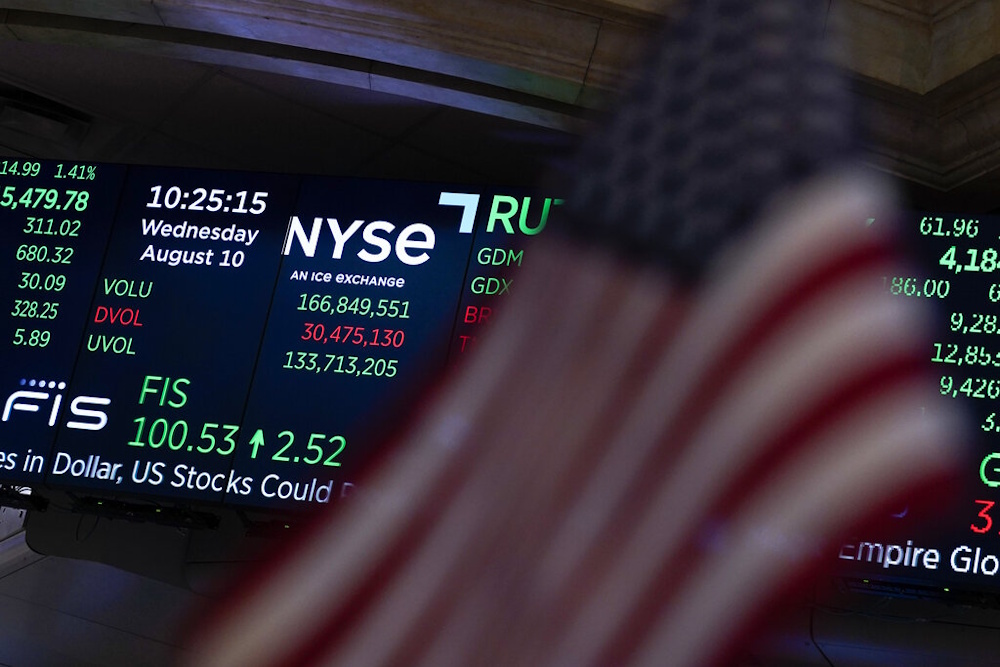
The major U.S. index futures are currently indicating a lower opening on Thursday, suggesting that stocks are poised to continue the downward trend observed in recent sessions. Concerns regarding inflation are poised to exacerbate the ongoing weakness observed on Wall Street, particularly in light of another significant rise in crude oil prices. U.S. crude oil futures are experiencing a significant increase of nearly 5 percent, following a rise of more than 3 percent on Wednesday. The price of crude oil has surged past $100 a barrel following President Donald Trump’s indication that the U.S.-Iran conflict may extend beyond the midterm elections. A report, referencing U.S. officials, indicated that senior White House advisers have discreetly suggested to Trump the possibility that the war may extend throughout the duration of his term. The futures experienced additional declines subsequent to the publication of the Labour Department’s report on producer price inflation for August. While the report indicated that producer prices rose in accordance with economist projections on a monthly basis, the annual rate of price growth accelerated beyond expectations.
The Labour Department reported that its producer price index for final demand increased by 0.4 percent in August, following a revised increase of 0.1 percent in July. Economists had anticipated a 0.4 percent increase in producer prices, contrasting with the unchanged figure initially reported for the prior month. The report also indicated that the annual rate of growth in producer prices accelerated to 5.4 percent in August, up from 4.8 percent in July. The annual rate of growth was anticipated to increase to 5.3 percent. Following initial pressure at the start of the session, equities experienced sustained weakness throughout the trading day on Wednesday. The major averages concluded the trading day in the red for the third straight session, as the Dow registered its lowest closing level in more than a month. The major averages concluded the day above their session lows, yet remained in negative territory. The Dow slid 405.41 points, or 0.8 percent, to 52,380.66; the Nasdaq declined 168.07 points, or 0.6 percent, to 26,253.34; and the S&P 500 fell 37.16 points, or 0.5 percent, to 7,636.36. The ongoing decline on Wall Street occurred alongside a prolonged increase in crude oil prices, as U.S. crude oil futures surged by over 3 percent.
The international benchmark brent crude futures surpassed $100 a barrel for the first time since July. The increase in crude oil prices is attributed to the destruction of five Iranian crude oil carriers by U.S. forces, following a targeted action by the Islamic Revolutionary Guard Corps against U.S. interests. Navy warship equipped with ballistic missiles. United States Central Command reported that Iran has utilised the tankers as a component of a multibillion-dollar shadow network that finances the IRGC and its regional proxies. Iran responded by launching a series of missiles aimed at U.S. military installations in Jordan, heightening concerns about the potential for an expanded regional conflict. The significant rise in crude oil prices has sparked fresh apprehensions regarding the inflation outlook in anticipation of the Federal Reserve’s upcoming monetary policy meeting next week. “Brent crude pushing above $100 a barrel has had a psychological effect on the market, pushing a hypothetical inflation worry gauge to ‘serious’ status and dragging down financial assets,” said Dan Coatsworth.
“The oil price has now jumped by 28% since early August,” he added. “This type of ascent could leave businesses and consumers feeling sick at the thought of sharp cost increases and potentially higher borrowing costs if central banks choose to fight inflation with interest rate hikes.” However, traders appeared to exhibit a degree of hesitance in executing more substantial transactions in anticipation of the forthcoming release of critical inflation data. Despite the broader markets’ weakness, the majority of major sectors concluded the day with only modest fluctuations. Retail stocks exhibited a notable decline, with the Dow Jones U.S. Retail Index decreasing by 1.5 percent. Considerable weakness was also evident among networking stocks, as indicated by the 1.4 percent decline recorded by the NYSE Arca Networking Index. Telecom, housing, and transportation stocks experienced significant declines, whereas oil and gold stocks advanced in tandem with the rising prices of their respective commodities.