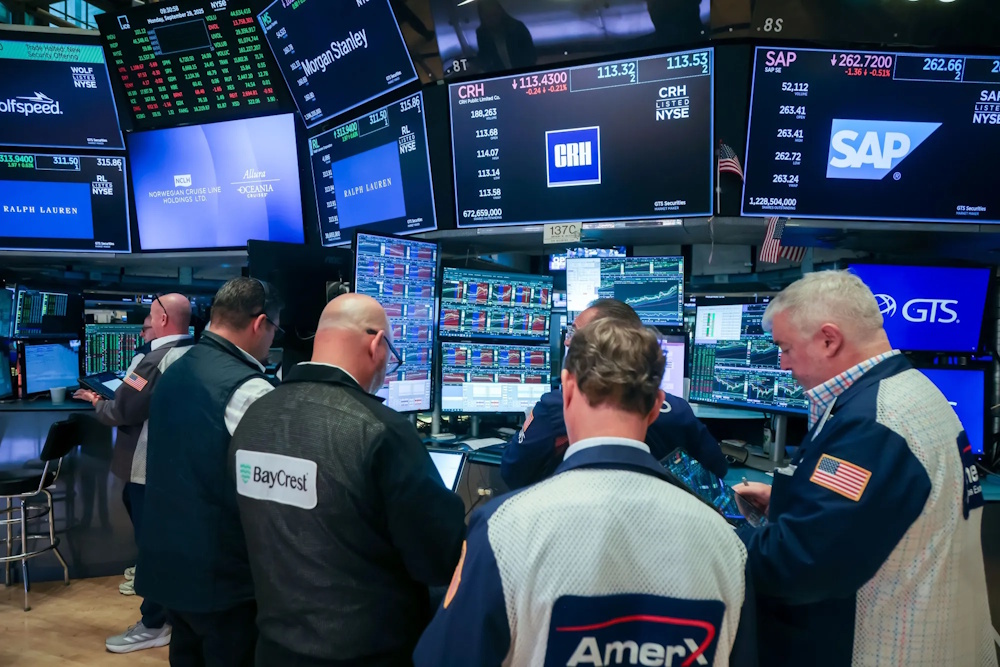
Global markets experienced a significant decline following a substantial sell-off on Wall Street, which resulted in an approximate loss of $2.5 trillion in market value on Thursday. This downturn was driven by concerns that the Democrats’ midterm successes might hinder the advancement of artificial intelligence development. South Korea’s Kospi experienced a significant decline of nearly 9% at the market open on Friday, prompting a 20-minute trading halt on the exchange. That followed the Nasdaq’s decline of 5.52%, resulting in a correction on Thursday, as it traded down over 10% from its peak on October 6. The tech-heavy Nasdaq experienced its most significant decline since April 2025, coinciding with President Donald Trump’s announcement of extensive global tariffs. Thursday’s sell-off extended to broader indexes, with the S&P 500 and the Dow both experiencing their worst day since April 2025. It represents a significant turnaround from Wednesday’s unprecedented post-midterm surge, during which the Dow increased by 1,569 points and the Nasdaq experienced a rise of 1.44%. By Thursday, the Dow closed 1,833 points lower, effectively erasing all of those gains. While the major indexes experienced an uptick on Wednesday, a closer examination reveals that shares of semiconductor chipmakers and firms engaged in the AI data center expansion were declining. On Thursday, the selling pressure intensified, resulting in a significant decline in the indexes.
The primary factor behind the sell-off is the Democratic victory in Texas’ gubernatorial race, as the state has been instrumental in propelling advancements in artificial intelligence. Major companies such as Google, Meta, Oracle, and OpenAI have significantly invested in data centers within the region. Texas Governor-elect Gina Hinojosa campaigned on a temporary moratorium for data centers and the elimination of specific tax incentives for businesses constructing data centers within the state. Shares of chipmakers and the “picks and shovels” of the data center buildout and AI boom are experiencing a decline as investors consider the ramifications of Democratic victories in states such as Texas, which are central to the development of planned data centers. Nvidia shares sank 9.3% Thursday, erasing their gains for this year. A closely monitored index of chipmakers experienced a decline of 12.3%, marking its most significant drop in approximately six-and-a-half years. Shares of Elon Musk’s Tesla and SpaceX dropped 11% and 9%, respectively. The Nasdaq 100, a smaller index comprising significant technology firms, declined by 6.36%, marking its most substantial drop since March 2020, a period when the emergence of the Covid-19 pandemic disrupted financial markets.
Shares of CoreWeave and Nebius, two neoclouds that rent out compute power for the AI boom, plunged roughly 10% and 15%, respectively. CoreWeave shares have experienced a decline of 76% since reaching a peak in June 2025, shortly after the company’s initial public offering. Nebius shares have experienced a decline of 58% since reaching their peak in June of this year. Investors are increasingly penalising companies that fail to meet earnings expectations or forecasts. Qualcomm on Wednesday reported results that fell short of expectations, citing that elevated memory chip costs are adversely impacting sales, a situation reminiscent of Intel’s guidance provided the previous week. Qualcomm experienced a decline of 9.5% on Thursday. Wall Street’s fear gauge, the VIX, which measures expectations for volatility, experienced a significant increase of approximately 70% – marking its largest one-day surge in nearly two years – and reached its highest level in seven months. The sell-off was extensive, as all 11 sectors within the S&P 500 concluded the trading session in negative territory. Nervousness surrounding AI equities and expectations of a decelerated data center expansion have strengthened government bonds. The 10-year Treasury yield decreased to 4.84%, marking its lowest point in two months. Keith Lerner interpreted this week’s volatile movements as more of a reflexive response rather than a genuine signal of the performance of stocks, especially in the technology sector, under Democratic governance of Congress Investors have predominantly grappled with the question of whether curbing the expansion of AI could present distinctive investment opportunities or exacerbate existing challenges.
On Wednesday, shares of Amazon, Meta, and Google – frequently labelled as hyperscalers in the AI buildout – experienced a notable surge driven by the expectation that the implementation of new restrictions would facilitate the allocation of cash that would typically be directed toward investments in data centers, consequently enhancing profitability. By Thursday, however, investors became disenchanted with those trades, likely apprehensive that new restrictions would result in a net negative outcome. As data centers become increasingly vital for powering a range of applications from artificial intelligence to the wider internet, the rapid speed of their construction has sparked concerns regarding the possibility of overbuilding. This raises the issue of whether companies are potentially committing to more computing capacity than the actual demand will ultimately warrant. Ed Yardeni, president of Yardeni Research, perceives a possible advantage stemming from the recent decline in the AI sector and the challenges associated with constructing data centers. “We want a slowdown in the AI buildout. It was too frenzied and speculative,” Yardeni told. “Now we are letting air come out of the AI bubble. It’s better to let air come out of the AI bubble than let it burst.”
At the same time, the tech sell-off represents a rare opportunity where the sector is by far underperforming the S&P 500. At a certain point, this kind of bargain could begin to appear increasingly appealing to investors, prompting them to acquire shares, stated Lerner from Truist. “In our view, the risk-reward is improving for longer-term investors,” he said. Technology has experienced significant volatility this year and is poised to maintain this trend with Anthropic’s forthcoming IPO and OpenAI’s anticipated IPO in the following year. The Nasdaq, characterised by its significant concentration in technology firms, experienced a correction in March, rebounded to achieve record highs in early June, faced a setback that brought it close to another correction in late July, and subsequently reached record highs again in September and October – only to descend into correction territory once more on Thursday. Overall, the Nasdaq and S&P 500 have declined approximately 12% and 6%, respectively, since reaching their highs on October 6. The Dow has declined approximately 5% from its zenith on August 5.