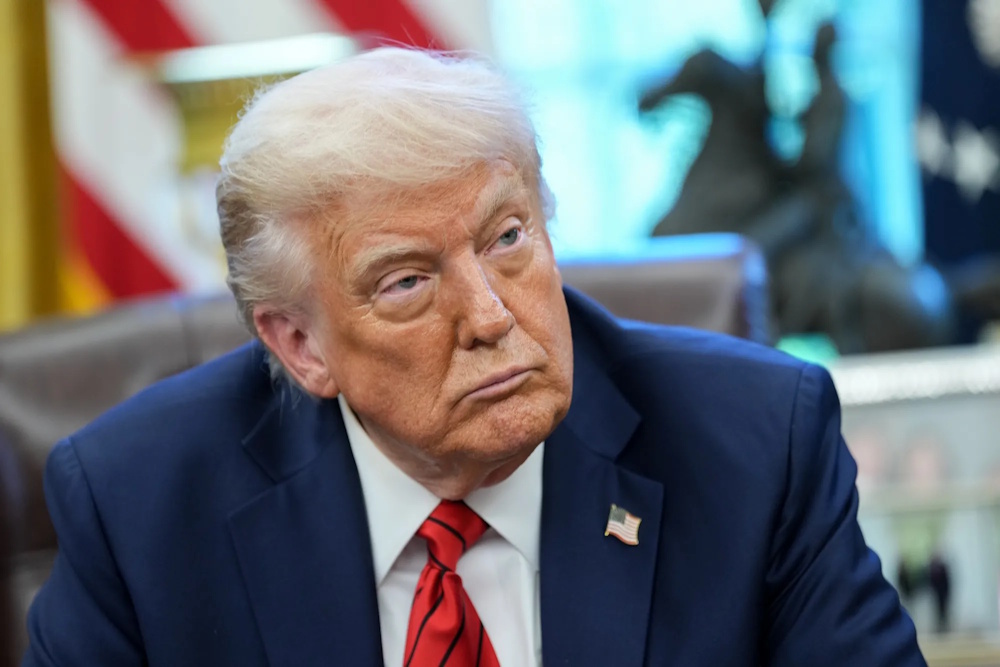
The major U.S. index futures indicate a lower opening on Thursday, suggesting that stocks are poised to revert to a downward trajectory after the modest recovery observed in the prior session. The downward momentum on Wall Street coincides with a surge in crude oil prices, driven by apprehensions regarding the conflict in the Middle East in the wake of President Donald Trump’s recent threats. In a recent post on Truth Social, Trump declared the initiation of “economic warfare” against Iran, describing it as the “most crushing economic operation ever taken against any country.” Trump also cautioned of “tremendous economic consequences” for any nation that “allows its financial institutions, businesses, airports, or government entities to provide any type of lifeline to Iran.” Responding to Trump’s threats, Iran’s Foreign Minister Abbas Araghchi described the so-called “Economic D-Day” as a “diversion from America’s own crisis: unprecedented debt & surging interest costs.”
“Doubling down on failed policies will only bring further defeat—and enmity of Iranians,” Araghchi said in a post on X. “US economic terrorism threatens global economy and sovereignty worldwide.” U.S. crude oil futures have surged over 3 percent, reaching their highest levels in almost a month, driven by concerns that recent rhetoric indicates an ongoing escalation in the U.S.-Iran conflict. The sharp increase in the price of crude oil has also contributed to a substantial rise in treasury yields, which had tumbled on Wednesday after the Treasury Department announced upscaled buyback operations for longer-term debt. A steep drop in shares of Walmart may also weigh on Wall Street, with the retail giant plunging by more than 7 percent in pre-market trading. The decline experienced by Walmart follows the company’s announcement of weaker than anticipated comparable sales growth in the second quarter, accompanied by lacklustre guidance for the future. Following the pullback observed over the past three sessions, stocks exhibited a slight recovery during trading on Wednesday. The major averages relinquished some gains following an initial upswing but ultimately concluded the day in positive territory. The Dow increased by 119.65 points, reflecting a 0.2 percent rise, reaching 53,463.05. The Nasdaq advanced by 41.38 points, also a 0.2 percent gain, totalling 26,331.09.
Meanwhile, the S&P 500 saw an uptick of 16.22 points, marking a 0.2 percent increase, bringing it to 7,707.98. The strength observed on Wall Street coincided with a notable decline in bond yields, as the thirty-year bond yield retreated further from its peak levels not seen in nearly two decades. Yields experienced a significant decline following the Treasury Department’s announcement of enhanced buyback operations for longer-term debt. The Treasury announced an increase in the scale of liquidity support buyback operations for longer-dated nominal coupon securities, with the size being raised by at least double, effective September 9th. “This increase in buyback operation sizes reflects Treasury’s desire to provide greater liquidity support in longer-dated nominal sectors where there is consistent strong sponsorship from market participants,” the Treasury said in a statement. Stocks retraced some of their earlier gains in afternoon trading, following the release of the Federal Reserve’s latest monetary policy minutes. The document indicated that a number of officials are of the opinion that an increase in interest rates may be required unless there is a notable decline in inflation. The Fed indicated that certain participants expressed concerns that current financial conditions may not be adequately restrictive to enable a return of inflation to the 2 percent target.
At the same time, the minutes underscored significant uncertainty regarding the inflation outlook, partly attributable to the recent re-escalation of conflict in the Middle East. “[Many] participants remarked that a protracted conflict could prolong supply chain challenges and could put upward pressures on inflation,” the Fed said. Fed officials reached a decision with a 9-3 vote to maintain the current interest rates during the meeting held on July 28-29. Notably, Cleveland Fed President Beth Hammack, Minneapolis Fed President Neel Kashkari, and Dallas Fed President Lorie Logan expressed a preference for an increase of rates by a quarter point. The Fed indicated that those participants advocating for an increase in rates believed that such a move would likely mitigate the necessity for a more pronounced and potentially more expensive series of tightening actions in the future. Gold stocks experienced a significant uptick in tandem with the price of the precious metal, as evidenced by the NYSE Arca Gold Bugs Index, which surged by 9.3 percent, reaching a three-month closing high. Substantial strength was also visible among biotechnology stocks, as reflected by the 4.2 percent spike in the Biotechnology Index. Pharmaceutical, healthcare, and housing stocks exhibited notable strength, whereas computer hardware, banking, and semiconductor stocks experienced significant declines.