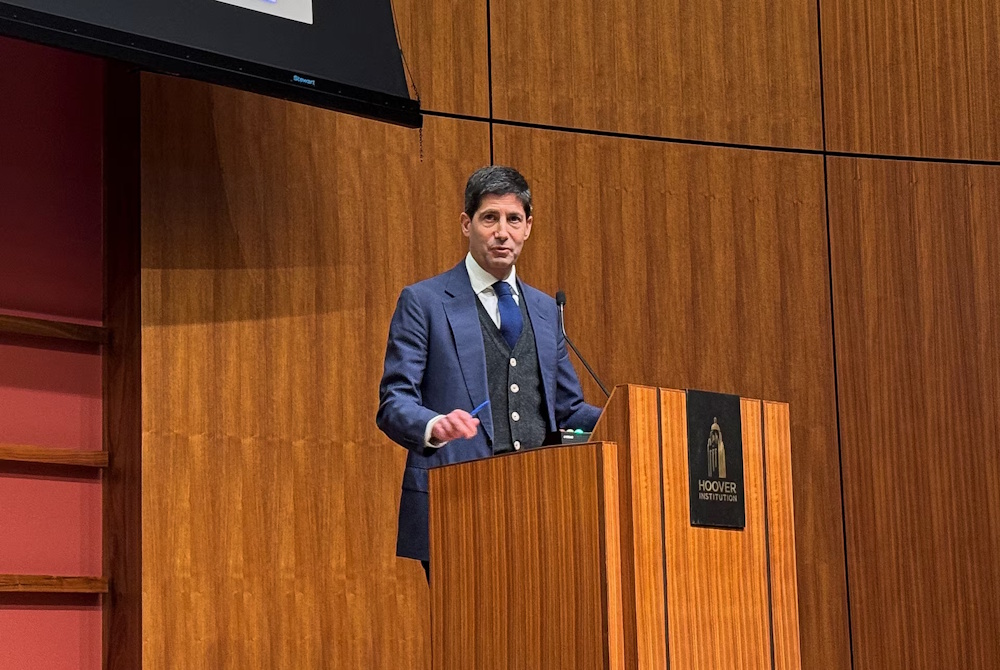
President Donald Trump’s selection to lead the globe’s most influential financial institution is currently impeded within a Senate committee. The individual maintaining the door’s closure identifies as a Republican, asserting that his opposition is directed not at the candidate, but rather at the president himself. The stark reality confronting Senate Majority Leader John Thune is underscored by the mounting anxiety among Republicans regarding the conclusion of a highly significant and politically charged confirmation battle in recent history. Kevin Warsh, nominated by Trump in January to succeed Federal Reserve Chair Jerome Powell, must navigate the approval of Republican Senator Thom Tillis, a pivotal member of the Senate Banking Committee responsible for all Fed nominations. Tillis remains steadfast in his commitment to obstruct the vote. Trump possesses a singular avenue for the confirmation of Warsh: Call for the cessation of the Justice Department’s investigation into Powell — an inquiry that has yielded no evidence of misconduct. However, Trump has declined, notwithstanding weeks of private appeals from Senate Republicans that have become progressively more public as the timeline approaches the conclusion of Powell’s term. Thune’s remarks following Warsh’s confirmation hearing this week are particularly revealing: “I am optimistic that the various issues concerning Chairman Powell can be addressed in a manner that facilitates Warsh’s progression from committee to the Senate floor.”
The more expediently the administration concludes this investigation and progresses, the more advantageous it will be for all parties involved. Is there a procedural alternative to circumvent Tillis? From a technical standpoint, the answer is affirmative. In practical terms, it is highly unlikely that this will occur. Here is the rationale. Confirming a Fed chair is not a matter of simply flipping a switch. The nomination is required to pass through the Senate Banking Committee prior to any action by the full Senate. The committee comprises 13 Republicans and 11 Democrats. In typical scenarios, Republicans maintain a solid majority, allowing Warsh to navigate through with ease. However, Tillis will not endorse Warsh as the DOJ investigation into Powell remains ongoing. Following his defection, the Republicans find themselves in a stalemate at 12. It is anticipated that every Democrat will cast a negative vote. The absence of a majority precludes the nomination from advancing to the Senate floor. The conventional route is obstructed. The Senate rules indeed incorporate a provision designed for precisely this scenario. A committee discharge is a procedural mechanism that enables the full Senate to bypass the committee stage and address a nomination directly on the Senate floor. In theory, it appears to be precisely what Thune requires. Any senator has the ability to submit a discharge resolution during the Senate’s operation in “executive session,” a distinct parliamentary procedure designated for nominations and treaties. The Majority Leader is then positioned to bring it forward for a vote. In principle, that vote necessitates merely a simple majority — 51 senators. The Republican Party currently occupies 53 seats. Mathematics resolved, correct? Far from it.
Issue one: The 60-vote barrier The Senate is unable to proceed with a vote to discharge the committee until it first votes to invoke cloture, thereby ending debate on the motion. And here’s the catch: the 2013 “nuclear option” — the landmark precedent that reduced the cloture threshold from 60 votes to a simple majority of 51 — pertains specifically to nominations. A discharge resolution does not equate to a nomination. This represents a procedural resolution. The distinction in question is far from a mere technicality. It is highly likely a definitive legal reality. The Senate Parliamentarian is expected to determine that the traditional 60-vote threshold remains in effect for the discharge resolution, despite the subsequent nomination requiring only a simple majority of 51 votes. The Republican Party holds 53 seats. Tillis casts a negative vote. The maximum is set at 52, which is eight votes below the required threshold. The trajectory is obstructed prior to its initiation. Issue two: Overcoming the barrier necessitates an alternative nuclear strategy The sole alternative is to amend the regulations once more — employing the nuclear option for a second instance, particularly to reduce the cloture threshold for discharge resolutions. That, in principle, necessitates merely 51 votes. However, this requires the Republican conference to undertake two successive extraordinary, precedent-setting actions regarding a nomination that is already caught in a presidential assault on the independence of the Federal Reserve — all while market participants scrutinize each development closely. Republican senators and senior aides indicate that the existence of 51 solid votes for that maneuver is highly improbable.
Issue three: The Fed chair operates within a safeguarded classification Even if discharge succeeded and a vote on Warsh reached the floor, he would not be regarded as a standard nominee. The position of Fed chair is classified as a Level I Executive Schedule role, placing it on par with Cabinet secretaries. A 2019 Senate precedent change reduced post-cloture debate to two hours for the majority of executive nominees, while explicitly excluding Level I positions. Warsh would be entitled to a maximum of 30 hours of debate following cloture. Democrats would utilize every moment — transforming a procedural workaround into an extended, market-disrupting spectacle. Not catastrophic, yet it represents an added expense on a trajectory already fraught with hazards. Issue four: Historical evidence indicates it is ineffective Contested discharge motions — those lacking unanimous consent — have become virtually non-existent. The most recent attempts occurred in 2003, 1989, and 1981. None were successful. The contemporary anomaly occurred during the evenly divided Senate of 2021-2022, and it was solely due to the fact that both parties engaged in negotiations that resulted in a power-sharing agreement, thereby modifying the rules through mutual consent. This dynamic is absent in this context. Consent is absent. Tillis is present. Certain individuals have referenced a 1980 precedent which asserts that the motion to enter executive session for a discharge vote is non-debatable — indicating that Thune could facilitate Warsh’s entry into the room without necessitating a cloture vote. That is indeed a reality. However, merely gaining entry does not equate to achieving victory in the ensuing struggle. The discharge mechanism of the Senate was conceived as a theoretical pressure valve rather than a practical instrument of force. Throughout more than two centuries, it has rarely been effectively utilized against organized resistance from within the majority’s own ranks.
Eliminate the procedural intricacies and the underlying political truth becomes evident: Thune must orchestrate a chain of institutional upheavals — meticulously timed, with no room for mistakes — to secure the confirmation of a nominee whose sole impediment stems from a self-inflicted controversy within the White House. In taking this action, he would be directly opposing a fellow member of his own conference, whose public position is likely echoed in private by several of his GOP counterparts. This situation elucidates why it is not regarded as a viable option currently. As long as Tillis maintains his stance — and he has clearly articulated his position — Warsh’s route to the Federal Reserve is contingent upon one location: the White House. The inquiry was never centered on the capabilities of John Thune regarding Senate regulations. The inquiry revolves around the possibility of Donald Trump intervening in the Justice Department’s activities. Until that changes, no procedural maneuver in the Senate rulebook positions Kevin Warsh as the next chair of the Federal Reserve.