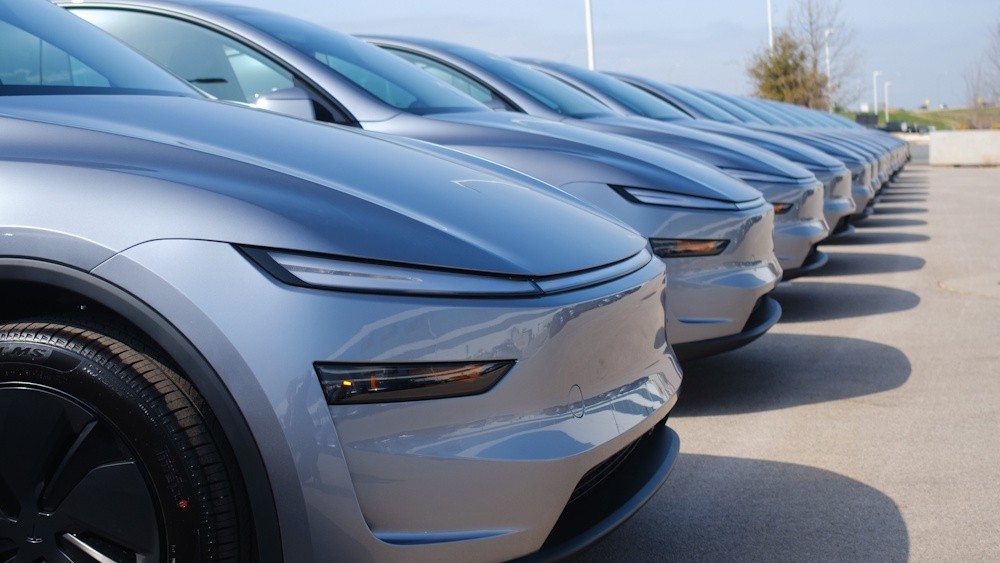
Two prominent robotaxi companies are currently functioning on US roads, yet their methodologies diverge.Amazon-backed Zoox has commenced public rides in San Francisco and Las Vegas utilising its purpose-built robotaxis, while Tesla is gearing up to introduce its purpose-built Cybercab into its Robotaxi service in the near future. Both companies are engaged in the development of vehicles intended for autonomous operation; however, their methodologies diverge in terms of vehicle design, deployment strategies, and manufacturing processes. Zoox’s robotaxi was constructed entirely without a steering wheel or pedals, in contrast to Tesla’s current Robotaxi service, which utilises Model Y vehicles. Tesla’s Cybercab is being developed devoid of traditional driving controls. Reuters, in a report published last week, indicated that Tesla was gearing up to initiate a Cybercab rollout in Austin, Texas, as early as August, initially providing rides to employees on public roads prior to integrating the vehicles into its Robotaxi service. Tesla’s website currently characterises Cybercab as a purpose-built fully autonomous vehicle that is set to provide rides in customers’ areas “in the future.” The company has yet to announce a definitive public launch date on its Robotaxi website. Zoox has engineered its robotaxi with a focus on autonomous functionality. A report published earlier this week, characterised its vehicles as “toaster-shaped.” The vehicle is designed without a steering wheel or pedals, accommodating four passengers in two rows that face one another. It is also bidirectional, indicating that it lacks a traditional front or rear. “Zoox has no front or back and can go in any direction,” the company stated on its website.
The vehicle employs a four-wheel steering mechanism and is equipped with an active suspension system. The company engages in the manufacturing of the vehicles internally. The report indicated that Zoox operates a fleet of approximately 100 vehicles, manufactured at a facility in Hayward, California, which boasts an annual production capacity of around 10,000 vehicles. Tesla’s Cybercab also lacks traditional driving controls. The two-seat vehicle was initially introduced in October 2024 and is designed without a steering wheel or pedals. Tesla has stated that the Cybercab is a purpose-built fully autonomous vehicle. “Cybercab, our purpose-built fully autonomous vehicle, will offer rides in your area in the future,” Tesla, on its website, said. Zoox is currently engaged in the operation of a public robotaxi service. The website indicates that Las Vegas and San Francisco are its current operating locations, while Austin and Miami are identified as areas for expansion. In San Francisco, Zoox announced that public riders have the capability to request rides via its service. In Las Vegas, riders can additionally utilise the service at specified locations. Tesla has also commenced the provision of autonomous Robotaxi rides; however, the existing service utilises Model Y vehicles instead of the Cybercab. Tesla’s website indicates that Robotaxi rides are presently available in Austin, Dallas, and Houston in Texas, as well as in Miami, Orlando, and Tampa in Florida.
Tesla’s Cybercab is undergoing preparations for an independent rollout. Tesla is hosting a Cybercab launch event in Austin, promoting the vehicle via its Robotaxi program. Zoox has already navigated the regulatory framework necessary for the operation of its purpose-built vehicles. The source reported that the company received permission to operate up to 5,000 vehicles under specified road and weather conditions, following regulatory concerns during the development process. Tesla’s current Robotaxi deployment is distinct as the service operates with Model Y vehicles, whereas the Cybercab is still in the rollout phase. The company’s own website currently describes Cybercab as “a vehicle that will offer rides in the future.” The source reported that Tesla’s Cybercab launch is anticipated to commence with employee rides on public roads prior to the vehicle’s integration into the company’s Robotaxi service in Austin. It was also reported that state laws mandate that numerous Tesla Robotaxi vehicles currently in operation must have a human supervisor or driver on hand to assume control when required. Zoox has established a specialised serial production facility for its purpose-built robotaxi in Hayward, California. The 220,000-square-foot facility is capable of assembling over 10,000 robotaxis annually at full capacity, as stated by the company.
It manages the assembly of robotaxis, oversees component storage, facilitates engineering and software-hardware integration, coordinates shipping and receiving, and conducts end-of-line testing. Zoox employs a modular assembly approach, bolstered by the symmetrical design of its robotaxi. Major components are preassembled by suppliers and subsequently integrated at the facility. An automated transport system facilitates the movement of vehicles between stations, whereas the majority of assembly tasks are performed by workers. Robots are deployed for particular functions, such as applying adhesive in glass installation and transporting the robotaxi along the assembly line. The company integrates diagnostics and testing into the manufacturing process, rather than deferring most checks until the conclusion of production. Zoox stated that this enables the testing of electrical and software components during installation, facilitating the early identification of issues in the build process. The final stage is end-of-line testing, which is tailored specifically for the autonomous vehicle. Each robotaxi undergoes a series of rigorous evaluations, including sensor calibration, wheel and headlight alignment, powertrain testing, water-leak testing, and functional checks, prior to an autonomous test conducted on a closed track. The final dynamic test entails the robotaxi operating independently to verify the integrity of its complete autonomy system.
This approach diverges from traditional vehicle manufacturing as Zoox must validate not only the vehicle itself but also the systems responsible for driving operations. Corrado Lanzone, Zoox’s vice-president of manufacturing and operations, on its website, said: “We are not building just a car; we are building the driver as well, which is the computer, the brain, the sensor systems, the eyes, and the ears of our robotaxi.” Tesla is adopting an alternative manufacturing approach for the Cybercab. The first production Cybercab rolled off the line at Gigafactory Texas on February 17, 2026, with volume production targeted from April, according to Forbes. Tesla is employing its “Unboxed” manufacturing process for the Cybercab. Rather than employing a traditional sequential assembly line for vehicle production, the process involves the simultaneous construction of several key modules, which are subsequently integrated during the final assembly phase. Forbes reported that the methodology entails the separate assembly of five to six principal modules prior to their integration. Tesla stated that its manufacturing facilities employ robots in conjunction with human labour, particularly for activities such as lifting vehicles and aligning components. The company stated that its manufacturing operations possess the capability to produce in excess of one million vehicles annually across its facilities.