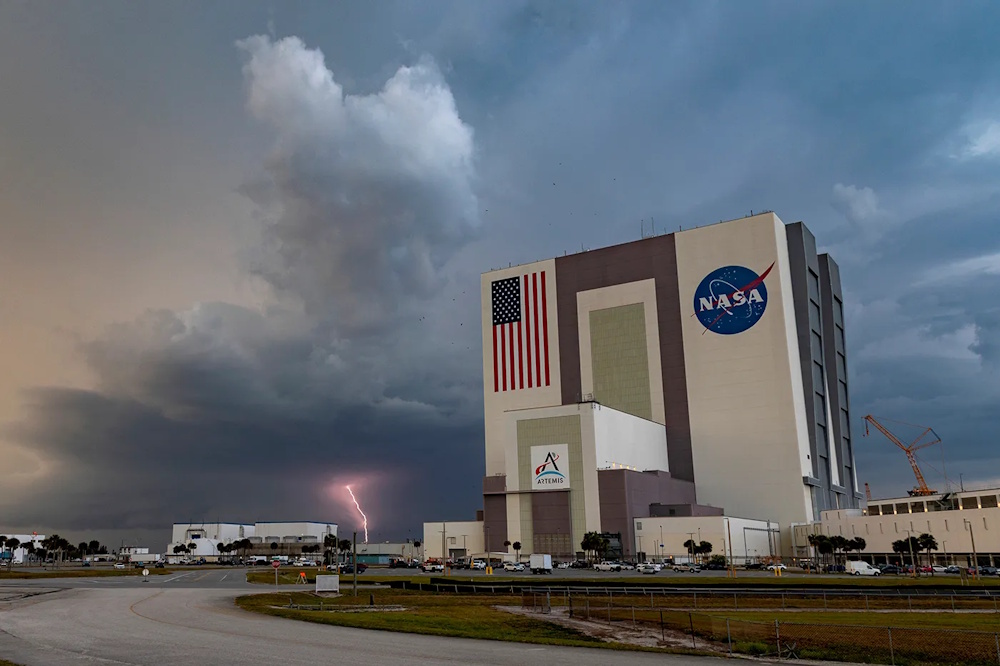
A three-armed spacecraft successfully ascended into orbit on Friday with the objective of salvaging a Nasa telescope that faces the imminent risk of re-entering Earth’s atmosphere. Northrop Grumman successfully launched Katalyst Space Technologies’ Link spacecraft from the Marshall Islands in the Pacific. The Pegasus rocket launched from the underside of a modified aircraft, setting Link on a trajectory to rendezvous with Nasa’s Swift Observatory in approximately one month. Launched in 2004, Swift is experiencing a rapid decline due to recent solar storms. Nasa is allocating $30 million to Katalyst for the purpose of capturing the telescope and enhancing its orbit, thereby enabling it to persist in monitoring significant cosmic events, including gamma-ray bursts and supernovae.
If all proceeds as anticipated, Swift may resume its cosmic observations by September. Observations are presently suspended to maintain the telescope’s orbital integrity for an extended duration. Nasa’s Hubble Space Telescope may emerge as a potential candidate for a comparable salvage operation in the coming years. It is also experiencing a decline in altitude due to heightened atmospheric drag resulting from the Sun’s outbursts. The 1.6-tonne Swift is presently in orbit at an altitude of 224 miles above the Earth’s surface. Katalyst aims to elevate the telescope’s altitude by 150 miles (240 km), returning it to its original position.
Link’s thrusters will engage to incrementally enhance Swift’s velocity, thereby circumventing abrupt accelerations. Katalyst assembled the mission in a mere nine months. Nasa emphasised the need for an expedited timeline due to the telescope’s anticipated position, which will render recovery impossible by autumn. Without an orbital boost, it is anticipated to re-enter Earth’s atmosphere in October. “This is a high-risk, high-reward mission,” Ghonhee Lee said ahead of liftoff. “The biggest danger was always that we don’t launch anything, and we let Swift burn up in the atmosphere. So we were always trying to avoid that risk, and our team has done that.”