

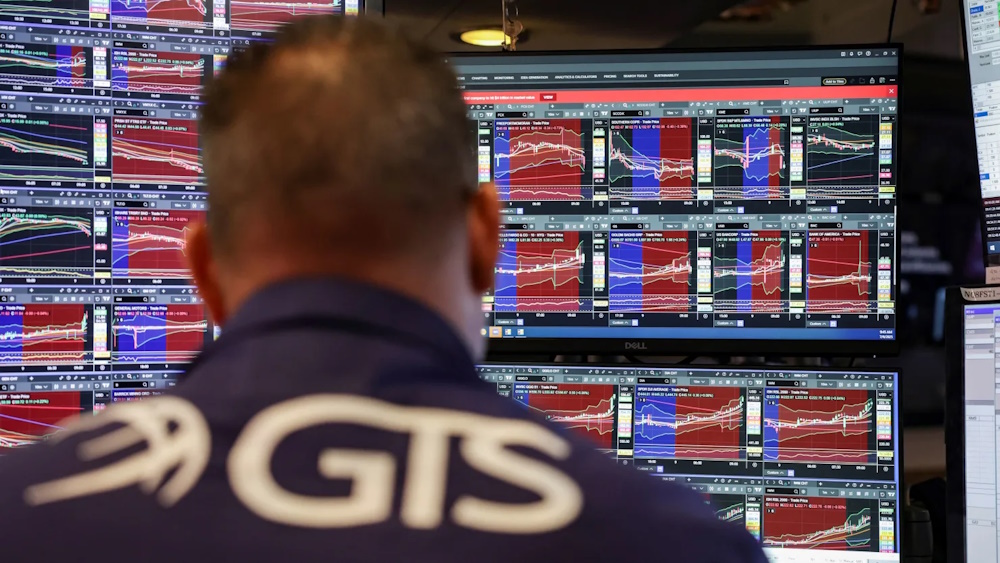
US stocks and bonds experienced a decline, while oil prices increased, and gold faced its most significant weekly drop in forty years, as the ongoing conflict in Iran continues to impact financial markets. The Russell 2000, an index representing smaller companies that are more responsive to interest rate fluctuations, experienced a decline of 2.26% on Friday, entering correction territory with a drop of 10.3% from its peak in January. A “correction” refers to a situation in which a stock or index experiences a decline of 10% or more from its latest peak. The Dow experienced a decline of 444 points, equating to a decrease of 0.96%. The S&P 500 experienced a decline of 1.51%, while the technology-focused Nasdaq saw a decrease of 2.01%. Fear gauge experienced an 11% increase.
The Nasdaq experienced a decline that pushed it into correction territory before recovering some of its losses as the trading session approached its conclusion. The Nasdaq has declined 9.65% from its peak in late October, positioning the index on the brink of a correction. The Dow has declined approximately 9.2% from its peak on February 10, while the S&P 500 has experienced a decrease of 6.77% from its peak in late January. The S&P and Nasdaq concluded trading on Friday at their lowest points since September, effectively nullifying six months of accumulated gains. The Dow concluded trading at its lowest point since October. The ongoing conflict with Iran is driving energy prices upward, heightening inflationary concerns and complicating the monetary policy landscape for central banks worldwide. The ambiguity surrounding the length of the conflict, coupled with the likelihood of sustained elevated interest rates to address inflation, is clouding the forecast for equities.
US Treasury yields surged on Friday as investors offloaded bonds and adjusted their outlook on inflation. The 10-year yield, a key determinant of mortgage rates, surged to 4.39%, marking its peak since July. “Investors initially thought that the Iran war would be short,” stated José Torres in a note. “However, as aggressions escalate with no resolution in sight, the distress on Wall Street persists, affecting both shareholders and holders of fixed-income assets concurrently.” The decline in equities and fixed income securities has spread beyond the confines of US markets. The UK 10-year bond yield experienced a notable increase, surpassing 4.9% on Friday, marking its highest point since 2008. London’s FTSE 100 stock index experienced a decline of 1.44%. US stocks experienced a decline Friday afternoon following a report indicating that the Trump administration is preparing for a possible deployment of US troops to Iran. Elevated bond yields have the potential to divert investors from equities.
Gold experienced a decline of 2% on Friday, resulting in weekly losses exceeding 10% and positioning the yellow metal for its most significant weekly drop since 1983. Brent crude, the global oil benchmark, experienced an increase of 3.26% on Friday, concluding at $112.19 per barrel. This marks its highest settlement to date during the conflict and the highest closing price since July 2022. US crude oil increased by 2.27%, reaching a price of $98.32 per barrel. The Dow experienced a decline for four consecutive weeks, representing its most extended period of weekly losses in three years. The S&P 500 experienced a decline for four consecutive weeks, representing its most extended period of weekly losses in the past year. “The stock market remains in negative territory for the year and has reached new lows this week, indicating that it may not have yet found its bottom. This situation suggests that the market is still in the process of assessing and pricing in the duration of the Middle East conflict and the outlook for oil prices,” David Laut stated.