

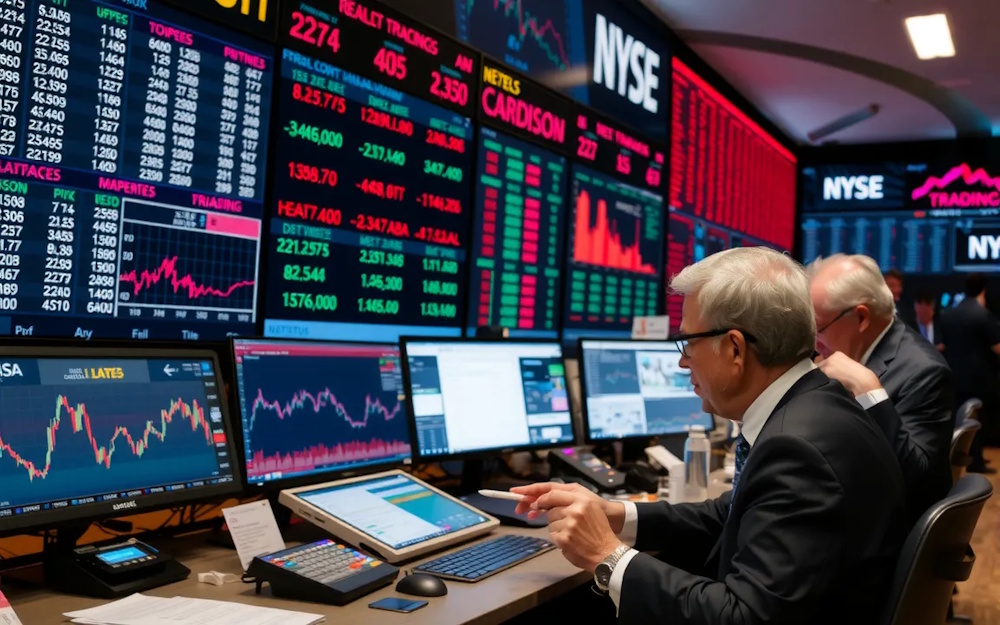
On Tuesday, a palpable sense of unease permeated the markets as equities faltered and bitcoin reached its lowest point since November 2024. The Dow concluded the trading session down by 167 points, representing a decline of 0.34%, following a significant drop of as much as 575 points at one point during the day. The broader S&P 500 experienced a decline of 0.84%. The tech-heavy Nasdaq experienced a decline of 1.43%. The S&P and Nasdaq experienced their most significant drop in two weeks, driven primarily by declines in technology and software stocks. In a reflection of the prevailing risk-averse sentiment, bitcoin earlier experienced a decline of nearly 7%, dropping just below $73,000 and reaching its lowest point since the election of President Donald Trump. Bitcoin subsequently experienced a modest rebound, trading at approximately $76,800. Bitcoin has experienced a decline of approximately 40% since reaching an all-time high exceeding $126,000 in October. The Trump administration has promoted pro-crypto policies, with the president asserting the intention to establish the United States as the “crypto capital of the world.” Despite backing from Washington, bitcoin has remained stagnant since its peak in October. The world’s largest cryptocurrency by market value has experienced significant price volatility and has faced challenges in recovering from a series of sell-offs. Despite declines in stocks and bitcoin, gold and silver experienced notable increases, further amplifying recent fluctuations. Gold futures experienced an increase of 6.7%, reaching a price of $4,965 per troy ounce. Silver futures experienced a remarkable increase of 10%, reaching approximately $85 per troy ounce.
Gold, regarded as a safe haven during periods of uncertainty, has surpassed bitcoin in performance over the last five years, as indicated by data. “[Bitcoin’s] divergence from gold is a sign that most investors currently view gold as the dominant store-of-value asset, especially in periods of currency debasement, geopolitical turmoil and uncertainty over macroeconomic conditions,” stated Gerry O’Shea. O’Shea anticipates ongoing near-term volatility for bitcoin as the cryptocurrency sector pursues greater regulatory clarity and integrates into the mainstream financial infrastructure; however, he believes that bitcoin’s attractiveness will grow. US stocks faced a setback as market processed the latest developments in the artificial intelligence sector. On Tuesday, AI startup Anthropic introduced enhanced functionalities for its Claude chatbot, which now includes support for tasks related to legal work. The announcement heightened concerns regarding potential disruptions to software firms that supply data and services to the legal sector. The sell-off occurs in the context of growing concerns regarding the potential impact of AI on the business models of software companies and the subsequent threat to their market share. Salesforce shares experienced a decline of 6.85%. According to Daniel Skelly, certain technology stocks are experiencing a temporary halt as investors seek opportunities in alternative sectors. “It’s notable that rotation is also happening within tech itself, as investors flee software due to ongoing fears of AI disruption, and shift towards other momentum winners, such as memory,” Skelly said. The Nasdaq, which last reached a record high in October, has declined by 3.18% from that peak. The Dow, having reached a record high in January, currently stands less than 1% below that peak. Tech stalwarts Microsoft and Amazon experienced declines of 2.87% and 1.79%, respectively. Nvidia, the star of the AI trade, experienced a decline of 2.84%, exerting downward pressure on markets.
Concerns persist regarding the profitability of the AI boom, particularly in relation to whether the substantial expenditures by companies will ultimately be warranted. Microsoft shares experienced a decline of 10% on Thursday, resulting in a loss of nearly $360 billion in market value, following the company’s report of slower-than-anticipated growth in cloud sales alongside heightened expenditures on AI. Market currently finds itself navigating through the corporate earnings season, with traders analyzing the results from the previous quarter. Investors are placing greater emphasis on spending forecasts and are concentrating on the capacity of companies to generate profits that can validate their expenditures. Despite a downturn in the markets, Walmart shares experienced a notable increase of 2.94%, propelling the company’s market value to surpass the $1 trillion threshold for the first time. Markets continued to decline, with increased volatility following reports of the United States intercepting an Iranian drone that was nearing a US aircraft carrier.
Fear gauge, the VIX, increased by 10%, reducing its gains after having surged as much as 25%. The VIX momentarily reached 20 points, a level indicative of heightened market volatility. Fear and Greed Index has transitioned from a state of “greed” to one of “fear.” Oil futures experienced an uptick as tensions between the US and Iran intensified. Brent crude, the international benchmark, experienced an increase of 1.6%, reaching $67.33 per barrel. West Texas Intermediate, the US benchmark, increased by 1.7% to $63.21 per barrel.