

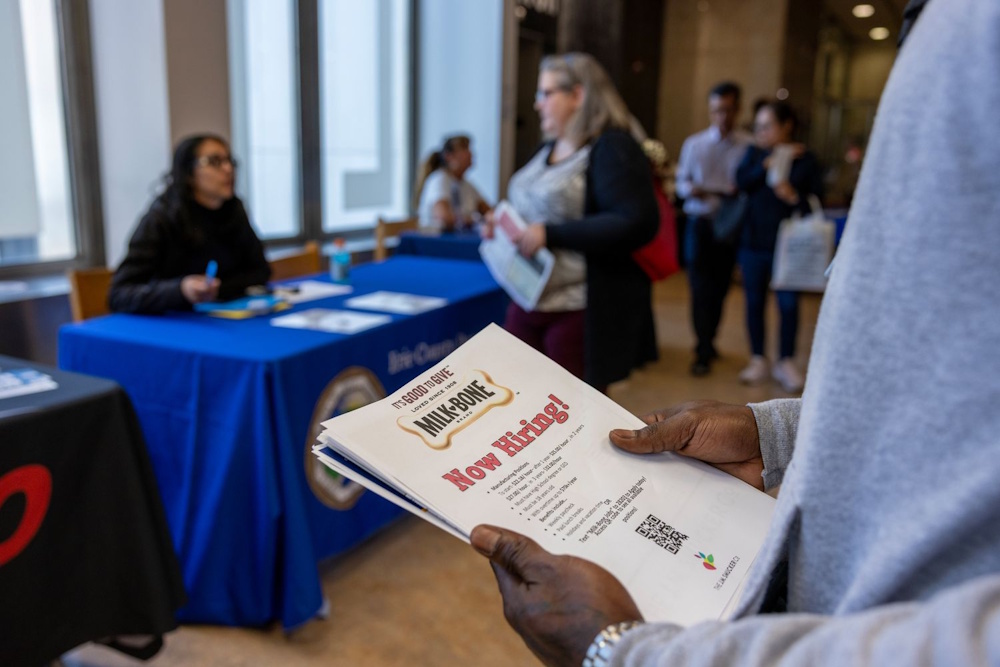
The most recent jobs report exhibited several shutdown-related anomalies; however, a consistent narrative emerged: The US labor market remains ensnared in stagnation. While employers continue to hire, the rate of job growth is currently among the lowest observed in the last twenty years. The “low-hire, low-fire” dynamics continued in November, as the unemployment rate increased, influenced in part by a greater number of individuals seeking employment without success. Long-term unemployment has seen an uptick, with a growing number of discouraged workers and a widening gap in economic disparities. “Hiring, while certainly not on a freeze, is on hold; and people that have jobs are absolutely holding on to them with white knuckles,” Dan North stated. “I perceive this as unequivocally a labor market that is experiencing stagnation.” What are the potential trajectories from this point onward? Some economists suggest that this low-gear state may persist for an extended period. However, some analysts suggest that a significant transformation in the labor market is inevitable, with multiple potential pathways for this change to occur.
The average monthly job gains in the US economy stand at 55,000, potentially indicative of the “pervasive uncertainty” stemming from significant shifts in US trade and immigration policy. However, the American population is undergoing its own transformation, according to Joe Brusuelas. The labor supply is contracting as the Baby Boomer cohort exits the workforce, compounded by heightened restrictions on immigration, he noted. There has been a notable shift in the “breakeven rate” of employment. In straightforward terms, the economy no longer requires the same level of job creation as it previously did to maintain its stability. “My estimate is that we need to hire 50,000 a month to keep the labor market conditions stable,” Brusuelas stated in an interview. The economy is projected to “grow at around 2%, financial conditions will be satisfactory, and we are likely to see a slight easing on the inflation front.” From an economic or capital markets viewpoint, that is a perfectly rational outcome and one that “could go on for years,” he stated.
However, “the K-shaped economy means that the disproportion of the benefits accrued from prosperity will not be distributed equally,” he added, indicating that wealthier households will fare better than poorer households as hiring slows. A significant variable at present is AI and its potential to transform the employment landscape. In the short run, uncertainties surrounding the technology are likely to keep businesses wary regarding their hiring decisions, as noted by economists at Pantheon Macroeconomics this week. “The longer-term implications for labor displacement and wage dynamics, however, remain an open question,” Seema Shah noted. AI, in conjunction with immigration enforcement and overarching policy uncertainty, continues to pose challenges to labor market expansion, according to Tyler Schipper.
“The question I pose is, ‘What conditions would lead to a resurgence in the labor market?’ Some of these factors are indeed related to policy,” he stated. “I find it difficult to envision those issues being resolved in the near future.” “For better or worse, I believe we may remain in this K-shaped economy for an extended period,” he added. “I believe the likely path forward involves experiencing a recession before conditions improve, which is certainly not the most reassuring perspective for those situated on the lower leg of the K.” Cory Stahle indicated that the labor market may experience a reacceleration in hiring. It may require some time to establish itself. “The US labor market resembles a sizable vessel steered by a rudder,” he stated. “At times, a period of adjustment is necessary for a reversal to occur.” One factor may be the recent interest rate cuts from the Federal Reserve, he noted, emphasizing that it generally requires approximately three to five quarters for adjustments in monetary policy to permeate the economy. Another factor could be policy changes or any other measures that alleviate Americans’ uncertainty, which has significantly hindered hiring this year. Additionally, the implications of the tax legislation scheduled to be implemented in 2026 are significant, according to RSM’s Brusuelas. “There’s uncertainty surrounding the trajectory of rates, ambiguity regarding prices, and a lack of clarity on overarching policy,” Stahle stated. “Unless that fog of uncertainty is lifted, we will persist in observing companies navigating somewhat clumsily through that haze.”