

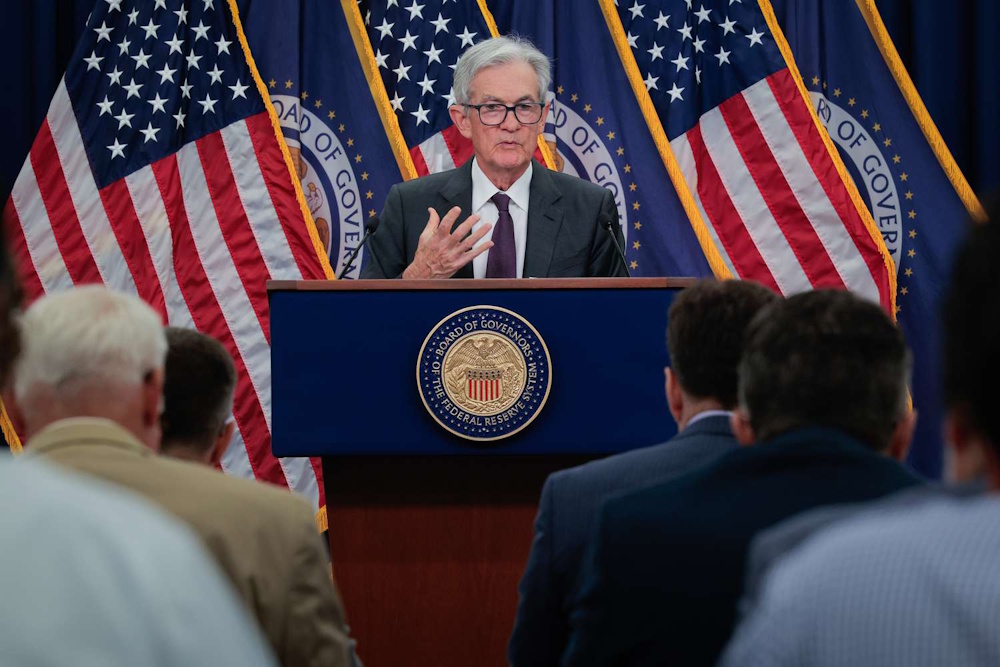
Market received the rate cut it sought. However, as the Federal Reserve prepares to adopt a more measured stance regarding interest rate reductions in 2026, investors find themselves grappling with additional issues that had previously been sidelined during the focus on Fed rate cuts. The Federal Reserve’s three successive rate reductions in September, October, and December facilitated a rise in market indices, allowing investors to overlook concerns regarding artificial intelligence and the ambiguity surrounding tariffs. With Fed Chair Jerome Powell indicating that rate cuts may be on hold for the foreseeable future, market’s attention is shifting to other matters. Uncertainty that had been simmering beneath the surface becomes increasingly difficult to overlook in the absence of Fed rate-cut optimism to support stock prices. Ongoing apprehensions regarding AI are reemerging, as recent developments in the bond market prompt some investors to reconsider their positions.
Market is adopting a more meticulous approach to analyzing the earnings results of AI companies. Oracle shares slumped 10.83% on Thursday following the company’s third-quarter results, which fell short of market’s expectations, and Oracle shares have experienced a decline of 39% since reaching a peak in September. “Oracle is entering into the heaviest phase of its AI infrastructure buildout, and [the third quarter] highlighted the timing mismatch of buildout spend to revenue conversion,” analysts noted. The ascent of the market in recent years can be attributed to the contributions of AI and technology stocks, and when investors divest from shares, it may exert downward pressure on the overall market. On Thursday, technology shares faced significant downward pressure. Nvidia fell 1.53%, while Alphabet declined by 2.27%, contributing to a decrease in the Nasdaq, which closed down by 0.25%. Investors shifted their focus to alternative sectors, resulting in the Dow advancing by 646 points, or 1.34%, to conclude at an unprecedented peak, while the S&P 500 experienced an increase of 0.21%, concluding the session at an unprecedented peak. “We’re not surprised to see near-term optimism in the markets, given that the Fed continues to cut rates even though the economy is growing,” stated Chris Zaccarelli. “However, we think the rose-colored glasses may come off once investors realize that the path to lower interest rates may take longer — or may not materialize at all — to the extent that they believe it will,” Zaccarelli stated. Affordability and the cost of living dominate the discourse surrounding the economy, and President Donald Trump persistently criticizes the Federal Reserve for its pace in reducing interest rates, expressing dissatisfaction with the current timeline.
The Federal Reserve’s benchmark interest rate exerts a significant impact on borrowing costs, including those associated with credit card rates. However, it is the yields on long-term bonds — such as the 10-year Treasury — that have a significant impact on borrowing costs, including mortgage rates. When the Federal Reserve reduces interest rates, bond prices generally increase, leading to a decline in yields and consequently lower borrowing expenses. However, a contrasting scenario unfolded recently: The 10-year yield reached its peak in three months before experiencing a decline on Wednesday, indicating that investors may be apprehensive about the potential for inflation to become a more enduring concern. Consequently, they require a greater yield to offset the potential erosion of their returns due to inflation. It serves as a poignant reminder that, despite Trump’s advocacy for lower rates, the bond market ultimately dictates the essential borrowing costs. Concerns regarding the burdens of government debt persist, bond yields are increasing in Japan, indicating a broader trend of escalating borrowing costs worldwide, and certain investors express concerns regarding the possibility of Kevin Hassett ascending to the position of the next Federal Reserve chair. Uncertainty persists regarding the anticipated ruling from the Supreme Court concerning a broad range of Trump’s tariffs. “Bond investors aren’t following the Fed’s easing script,” stated Ed Yardeni. “Concerns persist regarding substantial US federal budget deficits and the increasing US debt. Inflation continues to exceed the Federal Reserve’s target of 2.0%. Japan is currently experiencing a significant increase in bond yields.
According to Matt Maley, AI and bond yields pose two potential “headwinds” for markets as investors consider the outlook for 2026. “As it becomes increasingly clear that the AI industry is unlikely to achieve the broad profitability or rapid returns that the market anticipates, we foresee significant challenges ahead,” Maley stated. Meanwhile, Maley noted that the prospect of rising bond yields is “just as important” for markets. Increased bond yields typically lead to elevated borrowing costs, which may inhibit spending and business activity that could stimulate stock market performance. Simultaneously, elevated bond yields may divert investors from equities. “This pattern of rising long-term interest rates is highly unusual when we look at the historical reaction during Fed cutting cycles,” stated Torsten Slok. “The bottom line is that … investors across all asset classes must consider the underlying reasons for this occurrence.” Simultaneously, technology firms are engaging in debt financing to facilitate their ambitions of constructing infrastructure that underpins the burgeoning AI sector, and borrowing costs may increase should bond yields experience an uptick. “We believe that 2026 is going to face some real problems,” Maley stated.