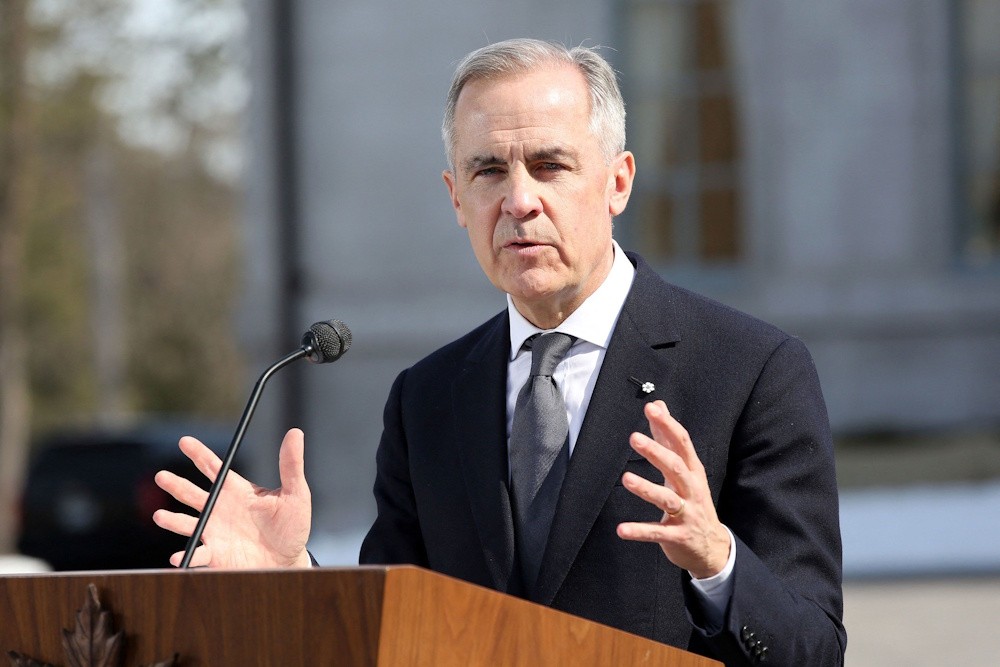
Trade negotiations between Canada and the United States collapsed unexpectedly on Friday evening, reigniting tensions in the North American trade landscape, as Ottawa pledged to reciprocate Washington’s tariffs. Despite optimistic declarations from both parties regarding the potential for an agreement to avert 50% US tariffs on a range of Canadian products set to take effect at the midnight deadline, negotiations stalled. Canadian Prime Minister Mark Carney indicated that the two nations were unable to come to a consensus to “meet our objectives.” And “As a result, this evening, I have decided to suspend trade negotiations with the US and have directed Canada’s negotiators to return to Ottawa,” Carney said in a statement. Currently, a 50% levy has been imposed on $20 billion worth of Canadian goods. “Canada will match those tariffs dollar for dollar to protect our workers and businesses,” Carney added. Trump and Carney, along with senior trade officials from both nations, maintained direct communication over the course of the week following the president’s decision to extend the tariffs by three days.
Earlier in the week, Trump stated: “We’ve come to a deal with Canada.” However, he noted that it was “still subject to finalisation of documents.” And “Despite the U.S. offer to Canada to receive the best treatment of any major exporter to our market, new demands and walk backs of other commitments by Canada have upended the careful balance reached in the past days,” US Trade Representative Jamieson Greer said in a post on X. Greer said the offer had included “significant tariff reductions on steel, aluminum, autos, and lumber” as well as “a historic economic and national security partnership.” But Carney said last-minute changes in the US terms “were unfair, uneconomic, and called into question the reliability of any deal.” The most recent standoff is a consequence of a trade relationship that has progressively worsened since Trump’s return to office. Trump implemented tariffs on significant Canadian sectors, such as automobiles, steel, and aluminium, prompting Canada to respond with its own countermeasures. While Carney retracted his most extensive countermeasures last year, Trump continued to express irritation over the bans imposed by Canadian provincial leaders on American alcohol.
The tariffs that are now going into effect are relatively limited in scope, covering about $20 billion worth of goods imported from Canada – roughly 5% of the total value of goods imported to the US from its northern neighbour last year. Individually, they are improbable to significantly affect American consumers, who are already facing pressure from elevated petrol prices. The more significant concern is the trade war that is emerging. Carney in his Friday statement said his government will introduce “additional measures to support Canadian workers and businesses,” adding to the nearly $25 billion provided in support over the past 18 months. He said Canada’s economic growth is “accelerating” and that Ottawa would “not allow any nation to determine our future.” The United States had been contemplating a reduction in tariffs imposed on Canadian steel, aluminium, and automobiles. Steel and aluminium have been subjected to 50% duties, with reports indicating that officials were contemplating a reduction to 25%. Meanwhile, Canadian automobiles have encountered duties of 25%, which are imposed solely on the non-US components. This arrangement permits manufacturers to subtract the value of American-made parts from the segment of the vehicle that is liable to tariffs.
Officials had deliberated on the prospect of reducing the rate to 15%. Trump has consistently voiced his grievances regarding the limitations imposed by Canada on the capacity of American dairy producers to operate within its market. While the country permits US dairy products to enter its market, it imposes restrictions on the volume allowed through quotas. Imports exceeding those quotas may encounter excessively high tariffs, thereby significantly limiting further US dairy sales. Trump had emphasised earlier this week that the deal, which had not been finalised, would be “great for our farmers.” And “Our farmers will no longer be held up because they were being hurt very badly by Canada,” he added. Trump is leveraging a relatively obscure statute from the 1930s, which has not previously been applied to impose tariffs in this manner. The move is all but certain to face legal challenges, as have many of the administration’s efforts to impose new levies.
However, unless judicial intervention prevents Trump from utilising the law in this manner, it may provide him with a significant new avenue to impose tariffs as high as 50% on Canada — and possibly other trading partners — whenever his administration assesses that they are engaging in discrimination against American commerce. In contrast to various other statutes that Trump has utilised in the reconstruction of his extensive tariff framework following the Supreme Court ruling earlier this year, this particular trade law, referred to as Section 338, seemingly does not establish a temporal constraint on the duties. Tariffs enacted under the law may persist indefinitely unless they are rescinded by Trump or a subsequent president. Moreover, the potential reach is extensive. The Canadian goods affected in this initial round extend well beyond the products central to Trump’s articulated complaints, encompassing nearly 500 items. Currently, Trump has exempted numerous goods that the US depends on Canada for, particularly energy, critical minerals, and fish; however, this situation may evolve.