

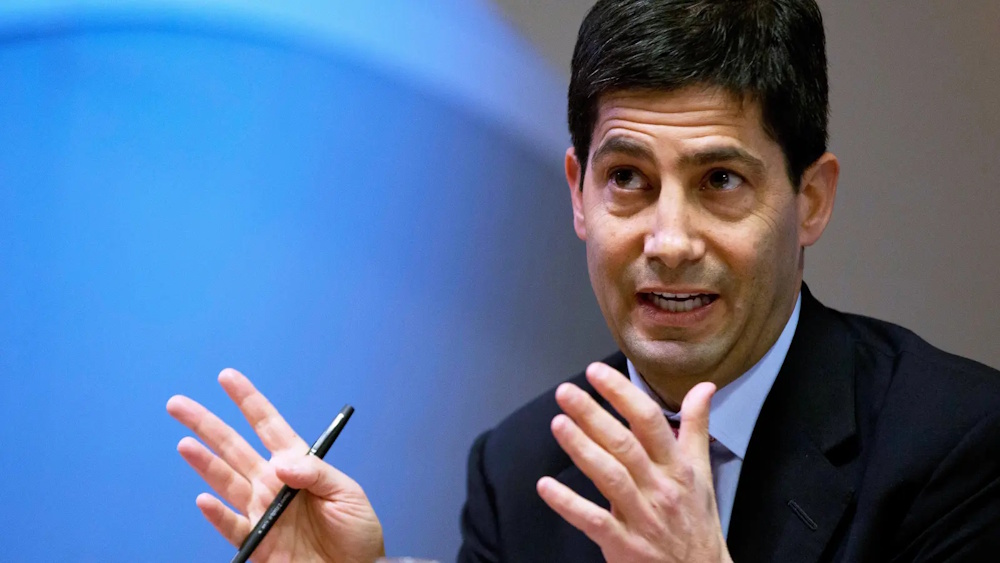
Advances in AI are unlikely to lead to a reduction in interest rates in the near term, according to a prominent Federal Reserve official on Tuesday — a significant divergence from the strategy proposed by Fed Chair nominee Kevin Warsh, which advocates for lowering borrowing costs. “I expect that the AI boom is unlikely to be a reason for lowering policy rates,” Fed Governor Michael Barr stated. In December, Warsh, who was appointed by President Donald Trump to lead the central bank following Fed Chair Jerome Powell’s term expiration in May, indicated that the integration of artificial intelligence in business would initiate “the most productivity-enhancing wave of our lifetimes.” The central bank ought to replicate the bold decision made during the internet era under Fed Chair Alan Greenspan and move towards reducing borrowing costs, he stated. Michael Barr engages in a board meeting at the Federal Reserve in Washington, DC, on October 24, 2025. Barr’s recent comments indicate that a divergence of opinion is emerging within the Federal Reserve’s influential 12-member rate-setting committee regarding the potential impact of AI on the global economy. This is significant as Federal Reserve officials possess only a single vote each, including the chair, during their eight annual meetings to determine interest rates. That implies Warsh would require the support of his colleagues to implement a reduction in rates.
In his speech, Barr delineated several avenues through which technology could influence hiring, productivity, and wages, asserting his expectation that AI “will have a transformative effect on the economy” overall. The anticipated effect of AI on the economy is that “some occupations are displaced while new ones emerge, as AI is increasingly integrated into many existing roles,” Barr stated. “However, the adoption of AI takes place at a pace that is sufficiently gradual to prevent significant and widespread unemployment,” he noted. Nonetheless, it is conceivable that “there might be serious short-term disruptions in the labor market,” which ought to be tackled by society collectively, including Congress, rather than solely by the Fed itself, Barr stated. Overall, AI has emerged as a prominent economic concern for central bankers globally. Alongside Barr, various other officials from the Federal Reserve, including Chair Jerome Powell, have indicated that the technology is expected to exert significant influence on the US economy — the degree and timing of which are yet to be determined. In his December interview, Warsh indicated that AI could be “structurally disinflationary,” implying that the Fed might have a straightforward avenue to persist in reducing rates.
In addressing a query, Barr countered that perspective, asserting it is “very hard to say that productivity would be disinflationary.” He noted that enhanced productivity, driven by AI, might elevate the neutral rate of interest, which is a theoretical benchmark for borrowing costs that neither stimulates nor constrains economic activity. “There’s more demand for business investment, the savings rate falls because people are anticipating longer lifetime earnings, and so all of that would suggest” a higher neutral rate, Barr stated. A higher neutral rate suggests that the economy is capable of enduring elevated interest rates, indicating that substantial rate reductions sought by the Trump administration are not justified.
Moreover, Barr is not the sole Federal Reserve official who shares this perspective. Cleveland Fed President Beth Hammack indicated that the neutral rate “could be more upward biased, if (AI) is having more material productivity impact.” Michael Hans stated “Technology has consistently acted as a disinflationary force within the ecosystem; however, it remains premature to assess the timeline for when productivity gains from AI will fully materialize.”