

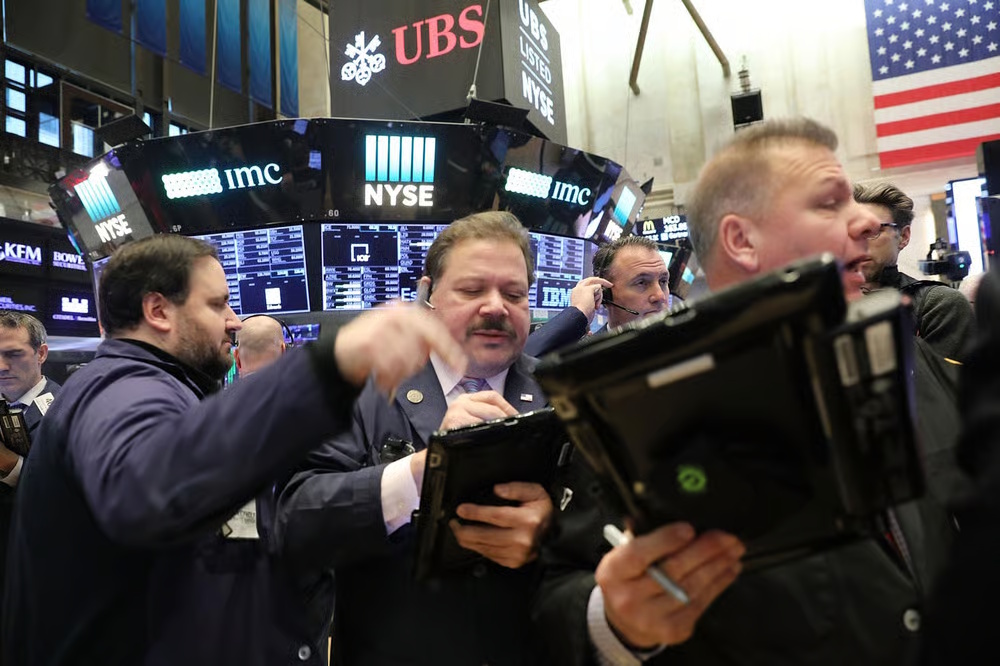
Equities declined, while gold experienced an uptick and volatility increased on Monday, driven by uncertainty surrounding President Donald Trump’s newly proposed tariffs and concerns regarding artificial intelligence that affected market sentiment on market. The Dow experienced a decline of 823 points, equivalent to 1.66%, marking its most significant drop in a month. The broader S&P 500 experienced a decline of 1.04%, while the tech-heavy Nasdaq Composite saw a decrease of 1.13%. Following the Supreme Court’s decision on Friday to invalidate the tariffs imposed by Trump under an emergency powers statute, the president declared over the weekend his intention to increase tariffs to a new rate of 15% on imports into the United States, utilizing a different legal framework.
The heightened emphasis on tariffs, coupled with uncertainty regarding possible refunds, is obscuring the forecast for equities. Fear gauge, the VIX, experienced a 12% increase on Monday, exceeding 20 points, a level indicative of heightened market volatility. Michael Landsberg noted that “the push and pull with tariffs is likely to be a distracting theme for markets for the remainder of the year, albeit with less volatility than the initial shock last April.” As investors contend with the latest tariff announcements, market faces ongoing challenges stemming from persistent weakness in technology and AI stocks. The tech-heavy Nasdaq has experienced a decline of approximately 5.8% since reaching a peak in late October. Concerns regarding the potential disruption caused by AI persistently influence market dynamics. On Sunday released a report on Substack outlining potential scenarios in which advancements in AI may impact various sectors of the economy. Stocks referenced in the report experienced a decline on Monday.
American Express shares experienced a decline of 7.2%, marking their most significant drop since April. Shares of DoorDash and private equity firm KKR, two other companies named in the post, sank 6.6% and 8.89%, respectively. Separately, IBM shares dropped 13.15% and experienced their worst day since 2000 after Anthropic published a blog post discussing how its AI tool Claude can assist in “breaking the cost barrier” to modernizing the popular COBOL (Common Business-Oriented Language) computer programming language. On Monday, over 60% of stocks within the S&P 500 experienced a decline in their closing values. Stocks managed to secure a modest gain on Friday; however, sentiment deteriorated over the weekend following Trump’s announcement of an increase in his newly proposed tariff from 10% to 15%. Gold, regarded as a safe haven in times of uncertainty, increased by 3.4% and surpassed $5,200 per troy ounce. According to Fear and Greed Index, the prevailing sentiment influencing markets was one of “fear.”
Ongoing apprehensions regarding private credit, coupled with tensions between the US and Iran, have contributed to market unease, as noted by Matt Maley. “Given the convergence of numerous uncertainties, it is not particularly surprising that stocks are showing signs of weakness,” Maley stated in an email. Bitcoin experienced a decline exceeding 4% over the last 24 hours, stabilizing near the $64,600 mark. The cryptocurrency remains in a state of stagnation this year, having declined nearly 50% from its peak exceeding $126,000 in early October. The US dollar experienced a modest depreciation relative to other major currencies. Treasury yields declined as investors acquired bonds. “The key issue for markets is not merely the tariff level itself, but the uncertainty regarding subsequent developments,” stated Daniela Hathorn.