

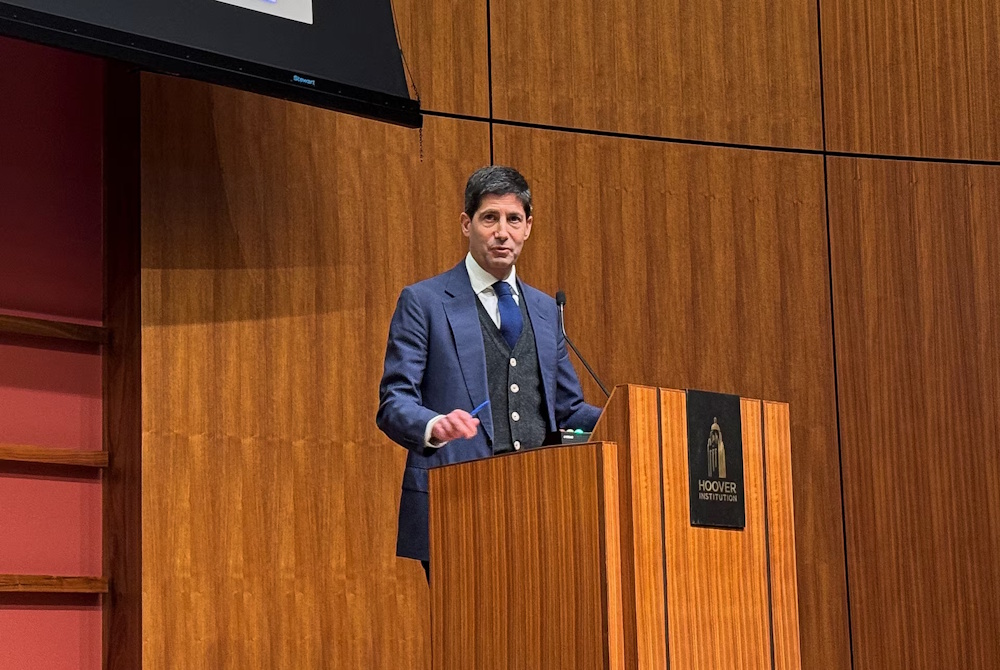
President Donald Trump announced on Friday his nomination of Kevin Warsh to succeed Jerome Powell as the 17th chair of the Federal Reserve, following the conclusion of Powell’s term in May. “I am pleased to announce that I am nominating Kevin Warsh to be the chairman of the Board of Governors of the Federal Reserve System,” Trump wrote. “I have known Kevin for a considerable duration, and I am confident that he will be regarded as one of the most distinguished Fed Chairmen, possibly the finest.” In a meeting held in the Oval Office later on Friday, Trump emphasized his selection, stating: “I would say that this was the perfect candidate.” This individual was the most qualified, a top student, attended the best schools, and had an impeccable record, being the youngest person ever to serve on the Federal Reserve. Received the complete set of offerings. “Aesthetics may not hold intrinsic value, yet one cannot deny that he possesses a certain appeal, correct?” Warsh represents a traditional choice for the position of Fed chair: he is a former Fed governor who had been considered for the role of Treasury secretary during Trump’s second term and was also a contender for the Fed’s top position in Trump’s first term. Warsh’s appointment to the Fed in 2006 at the age of 35 marked him as the youngest individual to ever hold a position on the Fed’s influential board. Warsh, now 55, has recently altered his perspective on monetary policy. A former inflation hawk, Warsh has recently expressed support for lower interest rates, as evidenced by various public statements he has made in recent months amid Trump’s reality-show-like spectacle surrounding his Fed chair decision. He has also advocated for a comprehensive restructuring of the central bank’s personnel.
“It’s reasonable to assume that he told the President he favors reducing interest rates today, otherwise he would not have been nominated,” noted Samuel Tombs. “It is reasonable to assume that Mr. Warsh will prioritize his historical legacy over catering to the President’s preferences.” The appointment of a new Fed chair represents a critical decision for any president, yet the significance of this nomination is amplified in the context of the current administration. Trump has committed to reducing the cost of living, while the Federal Reserve is tasked with ensuring price stability. Trump has criticized the Federal Reserve and Powell over the past year, admonishing Powell, whom he appointed as Fed chair, for failing to implement rate cuts. Earlier this month, Powell disclosed in a remarkable video statement that the Trump administration has initiated a criminal investigation into the Federal Reserve and its chair. In his remarkable criticism, Powell stated that the action was a “pretext” aimed at coercing the central bank into reducing rates to align with the president’s preferences. Trump’s dissatisfaction with Powell has been widely acknowledged; however, it remains uncertain whether he possesses the actual authority to terminate him. In August, Trump presented a termination letter to a gathering of House Republicans during a meeting at the Oval Office, as reported by three individuals with knowledge of the situation.
Meanwhile, the Trump administration is currently presenting its case before the Supreme Court regarding the justification for removing Fed Governor Lisa Cook, whom the president stated he dismissed in August. The independence of the Federal Reserve is under scrutiny in this significant case, as conservative Justices expressed skepticism regarding the administration’s legal arguments during oral discussions earlier this month. Trump’s selection for the head of the central bank concludes a thorough search process that initially evaluated approximately twelve candidates, ranging from prominent MAGA figures like National Economic Council Director Kevin Hassett to former Treasury Secretary Janet Yellen, as noted by Scott Bessent, Trump’s Treasury chief who oversaw the search. Bessent was also a candidate for the role but informed Trump of his preference to stay in his current position. Alongside Warsh, the remaining four contenders included National Economic Council Director Kevin Hassett, Federal Reserve Governor Christopher Waller, and BlackRock’s Rick Rieder. Christopher Waller, Rick Rieder, and others were interviewed for the Fed position. They all would have been outstanding and possess a great and unlimited future with “TRUMP.” The level of talent present in our country is truly remarkable. Thank you! On Friday, Trump made a statement on Truth Social.
Trump remarked in a different post that Hassett would have been “a great Chairman. But, quite honestly, he is doing such an outstanding job working with me and my team at the White House that I just didn’t want to let him go. Kevin is exceptionally skilled; thus, as the saying goes, ‘if you can’t do better, don’t try to fix it!’ The Senate Banking Committee is set to evaluate Warsh’s nomination during a public hearing, after which the full Senate will cast its vote on his confirmation. However, this process may be compromised by the Trump administration’s significant criminal investigation of Powell, a boundary that several prominent Republican senators indicated Trump has breached, potentially delaying Warsh’s nomination until the investigation concludes. “No Republican purporting to care about Fed independence should agree to move forward with this nomination until Trump drops his witch hunts of the current Chairman of the Federal Reserve and Governor Lisa Cook,” stated Sen. Elizabeth Warren. Trump’s attempts to inject politics into the Federal Reserve’s decision-making process pose a significant risk to the cherished independence of the central bank. It is highly probable that members of the Senate Banking Committee will inquire of Warsh regarding his evolving stance on interest rates and any commitments he may have made to Trump concerning policy formulation. He may also face inquiries regarding his father-in-law, Republican mega-donor Ronald Lauder. In 2002, Warsh entered into matrimony with Jane Lauder, a billionaire heiress in the cosmetics industry and a businesswoman, who is the granddaughter of Estée Lauder. Their meeting took place at Stanford.
Warsh served as an economist at the White House during the administration of George W. Bush. He is presently a visiting fellow at the Hoover Institution, a think tank with a conservative orientation located at Stanford University. While Trump is advocating for significant interest rate reductions to accelerate US growth, certain economists and analysts point out that Warsh has previously demonstrated a tendency to resist policies aimed at stimulating the economy. In April 2009, amid the Great Recession and a rising unemployment rate, Warsh voiced apprehensions regarding inflation. “I continue to be more worried about upside risks to inflation than downside risks,” Warsh stated during a Federal Reserve meeting, as noted in the subsequently released minutes. His rationale for resigning from the Fed in 2011 highlights his opposition to loose monetary policy — at least prior to his candidacy for Fed chair this time. “Kevin Warsh has consistently advocated for a hawkish stance on monetary policy throughout his career, particularly during a period when labor markets experienced significant downturns. “His dovishness today stems from convenience,” analysts posted on X Friday. “The President faces the possibility of being misled.” Warsh is regarded in economic and financial circles as a seasoned and credible policy figure with an extensive background. In his early tenure as a Federal Reserve governor, he was instrumental in navigating the financial crisis, collaborating closely with then-Fed Chair Ben Bernanke and former New York Fed President Timothy Geithner, who subsequently assumed the role of Treasury secretary.
Nonetheless, he has demonstrated his capacity for independence previously: He distanced himself from the central bank owing to policy disagreements regarding the crisis-management tools employed by the Fed following the Great Financial Crisis. He expressed skepticism regarding quantitative easing, specifically the substantial acquisition of Treasury bonds aimed at reducing long-term interest rates, later stating that such actions could potentially elevate inflation and extend the Federal Reserve beyond its fundamental responsibilities. “He got the policy response wrong in the aftermath of the Great Financial Crisis,” Joe Brusuelas stated during an interview. “He genuinely failed to grasp the nature, magnitude, and implications of the shock reminiscent of the Depression. During the defining crisis of our time – the Great Financial Crisis – Kevin Warsh continued to extoll inflation as the primary risk during 2007-08 as a massively deflationary event was unleashed via the near collapse of the American banking sector and freezing up of credit markets that ensued.”