

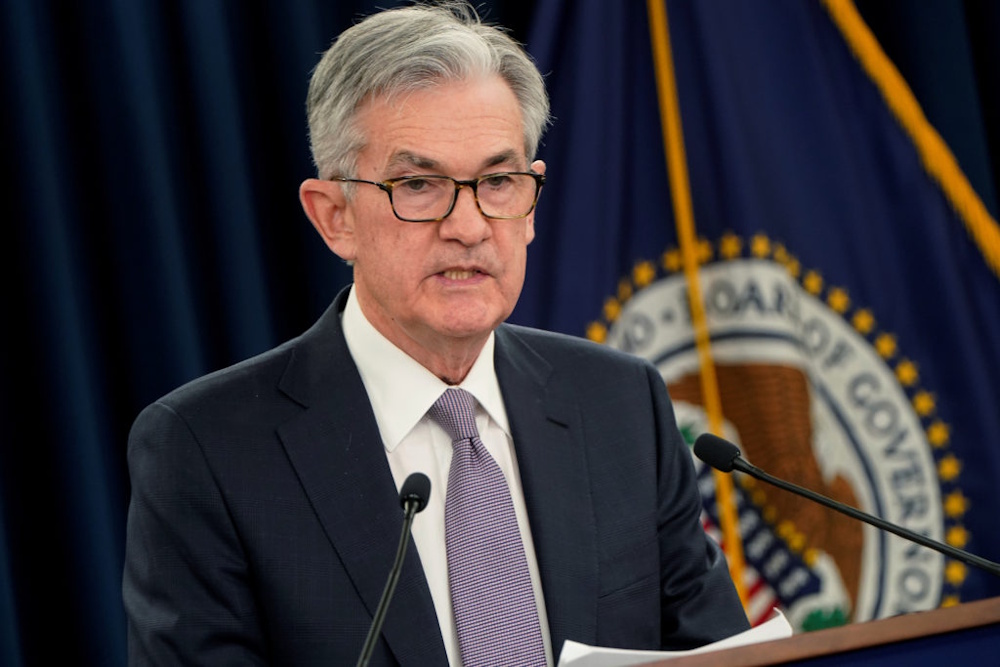
The Federal Reserve on Wednesday opted to maintain interest rates at their current levels, as the central bank seeks to preserve its autonomy in setting monetary policy free from political pressures. Officials maintained their benchmark lending rate within a range of 3.5-3.75%, after implementing three successive rate reductions late last year. Chair Jerome Powell suggested in his post-meeting news conference that this pause could endure for an extended period. The Federal Reserve chair was more reserved regarding his confrontation with the executive branch, which he previously tackled directly in a remarkable video addressing President Donald Trump. The decision to maintain the current stance was not reached unanimously, as Fed governors Stephen Miran and Christopher Waller – both appointed by Trump – expressed dissenting opinions, advocating for a quarter-point reduction. Waller stands as one of the four candidates for the position of Fed chair following the conclusion of Powell’s term in May. Historically, Waller’s dissenting opinions advocating for reduced interest rates have garnered positive reception from the Trump administration.
President Donald Trump indicated this week that he plans to announce his nominee for the Federal Reserve chair “pretty soon.” The anticipated decision will conclude a protracted search process that, at one stage, evaluated approximately a dozen candidates for the paramount position in global finance. The selection of Trump’s Federal Reserve chair stands as a critical issue for market, particularly as Powell has only two meetings remaining and market expectations do not foresee a rate cut until the summer. However, Powell provided insight into the committee’s general position regarding the outlook for monetary policy, indicating that there is no necessity for immediate rate reductions. “I think, and many of my colleagues think, it is hard to look at the incoming data and say that policy is significantly restrictive at this time,” Powell stated to reporters. In other words, lowering rates at this juncture appears illogical, given that the economy seems to be maintaining its stability. The Fed’s latest policy statement effectively justified the recent pause by characterizing economic growth as “solid,” marking an enhancement from the previous description of “moderate” in December’s statement. Officials noted that the unemployment rate has exhibited “some signs of stabilization.” Last year, the Fed reduced interest rates in response to indications of a weakening labor market, as central bankers aimed to avert a potential decline. Market participants anticipate two rate cuts in 2026, largely due to the expectation that the next chair of the Federal Reserve will prioritize a reduction in interest rates. “There isn’t a clear case to cut this year, but we know that the next Fed chair is going to come in leaning dovish, so there’s a decent chance they could get enough folks on the committee to be on board with a couple of cuts,” stated Aditya Bhave in an interview. “However, that individual may find it challenging to establish a consensus.”
The newly appointed leader of the central bank will oversee a 12-member rate-setting committee characterized by its divisions, which does not simply acquiesce to the chair’s proposed actions. This year, the committee has welcomed new members who have expressed ongoing concerns regarding inflation, including Cleveland Fed President Beth Hammack and Dallas Fed President Lorie Logan. “It’s not a committee of one, it’s a committee of many, and many have to decide that there is economic justification for cutting rates,” stated Tom Porcelli. Powell advised his successor, in response to a query: “Stay out of elected politics. Our window into democratic accountability is Congress, and it is not a passive burden for us to go to Congress and talk to people,” he stated. “It is a positive, consistent duty. “You earn it with the elected overseers, so it is something you need to work hard at, and I have worked hard at it.” Powell dismissed multiple inquiries from journalists regarding the federal investigation and political matters, adhering to his established approach of maintaining neutrality. However, he substantiated his rationale for participating in this month’s oral arguments concerning Fed Governor Lisa Cook, who is contesting Trump’s effort to oust her from her position on the influential Board of the central bank due to unverified claims of mortgage fraud. “I believed it could be challenging to articulate the reasons for my absence,” Powell stated.
“Furthermore, Paul Volcker, the former Chair of the Federal Reserve, was involved in a notable Supreme Court case around 1985, establishing a precedent that I believe is relevant.” A ruling against Cook would likely be perceived as a significant threat to the Federal Reserve’s political autonomy, a point that Powell reiterated in his recent remarks, asserting that it has “served the people well.” However, the conservative Justices on the Supreme Court appeared doubtful regarding the administration’s rationale for terminating Cook and its desire to prevent her from resuming her position during the ongoing litigation. That encompassed Justice Brett Kavanaugh, the second nominee of Trump to the Supreme Court. He cautioned that subsequent presidents might broadly interpret a “cause” to dismiss Federal Reserve officials with whom they have disagreements, should the Trump v. Cook case establish such a precedent. “What goes around comes around,” Kavanaugh remarked to US Solicitor General D. John Sauer, highlighting the potential for a future Democratic president to leverage “trivial or inconsequential or old allegations that are very difficult to disprove” as a means to remove Trump appointees.