

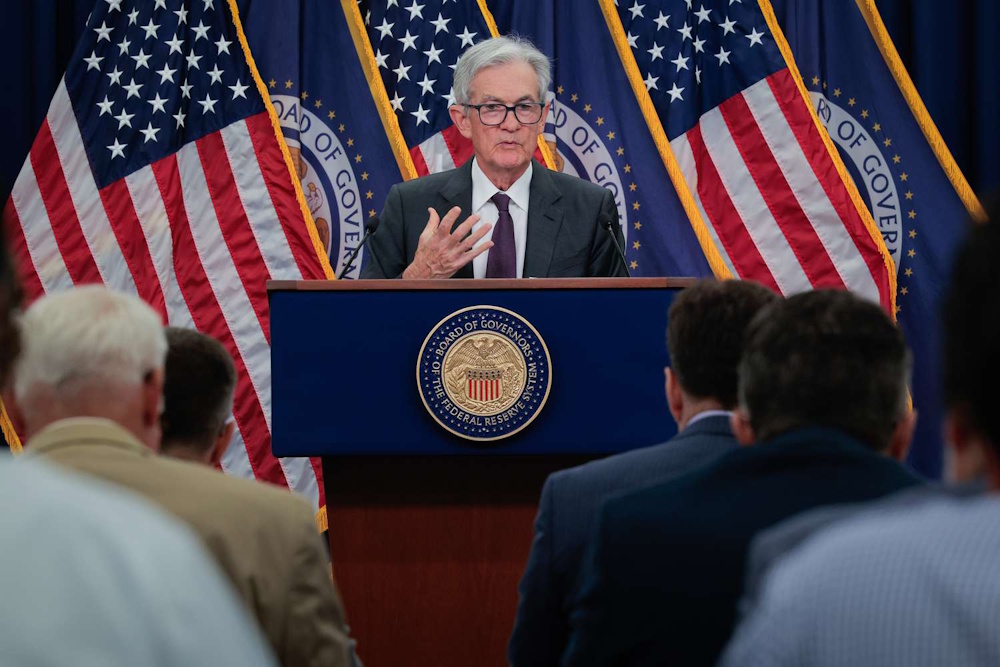
According to Federal Reserve Chair Jerome Powell, the optimal solution to address the cost-of-living challenges faced by Americans is to implement larger wage increases for workers. The proposed solution appears to be flawed as well. The US job market has exhibited stagnation in recent months, while wage growth has been on a consistent decline for over three years. On Tuesday, we will gain a more comprehensive understanding as the Bureau of Labor Statistics releases the postponed jobs reports for October and November. Affordability continues to be the foremost concern in survey after survey, even with over a year of relatively stable inflation and more than two years of wage increases surpassing price rises. This is due to the fact that Americans have not fully adapted to the price shock experienced a few years prior, when inflation reached a peak not seen in four decades. Debates among economists, business leaders, and politicians have centered on the most effective solutions to restore affordability to America’s cost of living, with discussions encompassing the enhancement of health care and housing subsidies as well as the reduction of tariffs. However, Powell, while explaining the rationale behind the Fed’s recent interest rate reductions, presented a more straightforward approach: Simply increase people’s earnings.
“We are going to need to have some years where real compensation is higher … for people to start feeling good about the affordability issue,” Powell stated last week. “Efforts are underway to manage inflation while simultaneously bolstering the labor market and ensuring robust wage growth, thereby enabling individuals to earn sufficient income and regain a sense of economic well-being.” The Federal Reserve anticipates that lowering interest rates will lead to decreased borrowing costs for businesses, thereby allowing them to allocate more capital towards hiring initiatives. An improved labor market would provide Americans with greater job options, thereby raising the compensation that companies must offer to retain and attract employees. Should this trend persist, individuals will gradually acclimate to the elevated prices, which will seem comparatively manageable as their earnings increase, Powell contended. Undoubtedly, this is a proposition that is more straightforward in theory than in practice.
The annual increase in hourly wages for American workers, which peaked at 5.9% in March 2022, has subsequently declined to a mere 3.8%. The observed trend can be attributed, in part, to inflation stabilizing and employers providing employees with reduced cost-of-living adjustments. However, it is also a consequence of a constricting labor market. Job growth has reached a virtual impasse, as overall hiring has declined in both June and August. The US economy has recorded an average of merely 76,000 jobs per month in 2025, a figure insufficient to sustain the growth of America’s population and less than half of the average job additions seen in 2024. The post-pandemic phase characterized by a worker-dominant labor market, marked by trends such as quiet quitting, has come to a definitive conclusion. Individuals currently employed are opting to remain in their positions, despite experiencing dissatisfaction. The proportion of employees who voluntarily left their positions decreased to a five-year low in October, according to the report. In a scenario where employers are not experiencing significant turnover, the motivation to offer substantial salary increases to retain employees diminishes.
Employers appear to be exhibiting a newfound willingness to engage in hiring activities. In October, job openings reached a five-month peak, while a notable 19% of small businesses indicated intentions to hire in November, as reported by the recent survey. The unfavorable development: Tariffs persist in jeopardizing the financial performance of businesses and driving up prices. Despite companies absorbing approximately 80% of President Donald Trump’s new tariffs to date, their profit margins are contracting, leading to an anticipated transfer of a significant portion of these costs to consumers through increased prices in the coming year, as reported by JPMorgan. Should the job market experience a resurgence, it is likely that salaries will see an increase as well. However, should inflation persist in its upward trajectory, increased wages will be eroded by escalating prices. The issue of affordability is unlikely to be addressed through that approach. Concerns regarding escalating inflation are the reason the Fed indicated that its campaign of rate reductions may be concluded for an extended period. While adjustments to interest rates may require several months to permeate the economy, halting the reductions suggests that the labor market may lack the necessary support it requires. For the US economy to extricate itself from its affordability predicament, recent trends must undergo a reversal. This week will provide greater clarity as the Bureau of Labor Statistics releases its jobs report on Tuesday, followed by the inflation report on Thursday.